
Google AI Contribution Report

Google Search Console Testing AI Contribution Reporting

Google Search Console Testing AI Contribution Reporting: An Overview of AI’s Role in Google Search

Understanding the impact of artificial intelligence on search engine optimization (SEO) is more critical than ever. Google is testing new ways to provide insight into how AI, particularly its AI overviews, influences search results. For businesses aiming to maintain or improve their online presence, grasping these changes is essential. Let’s dive into the intricacies of Google’s experimentation with AI and how the Google Search Console is evolving to offer valuable AI performance reports. If you’re struggling to keep up with these changes, consider partnering with The AD Leaf Marketing Firm for expert guidance.

Key Takeaways

  • Google is actively testing AI integration in search, impacting how content ranks and appears in AI overviews.
  • The Google Search Console now offers insight into how AI-generated summaries influence your website’s traffic and visibility.
  • Understanding AI contribution reports helps refine SEO strategies, ensuring content aligns with Google’s AI-driven search results.
  • Partnering with a knowledgeable firm like The AD Leaf Marketing Firm ensures your marketing strategies align with evolving AI search algorithms.

What is the Google Search Console AI Contribution Report?

The Google Search Console AI Contribution Report is a novel feature designed to provide SEO professionals and website owners insight into how Google’s AI overviews and AI-generated content impact their website’s performance. Google said that this tool is part of testing a new way to understand how artificial intelligence influences search results. This AI contribution pilot aims to offer a more transparent view of the interactions between search queries and AI-driven search results.

Understanding AI Contribution Reports

AI Contribution Reports within Google Search Console aim to break down how AI overviews and other AI-generated content affect your website’s visibility. These reports provide a benchmark for understanding the impact of AI on your organic search traffic. Analyzing these AI performance reports can help you understand the specific queries that trigger AI overviews and how often your site is featured within Google’s response to those queries.

How Google is Testing AI in Search

Google is testing new and innovative ways to integrate AI into its search engine. One notable experiment is Google’s AI-generated answers. These AI overviews offer users a summarized version of search results at the top of the page. Google Search is evolving to provide more direct and concise information, utilizing generative AI to answer user queries efficiently. This ongoing testing includes experimenting with new AI and the rollout of Gemini 3 to enhance query understanding.

Importance of AI-Generated Content in SEO

The rise of AI-generated content and Google’s AI overviews has significant implications for SEO. If Google’s AI-generated answers become the primary way users consume information, traditional ranking factors may shift. Optimizing content not just for traditional search results but also for inclusion in AI-driven summaries is crucial. The AD Leaf Marketing Firm can assist in adapting your SEO strategies to align with these new realities.

How Does Google Search Console Enhance AI Insights?

Google Search Console is becoming an essential tool for understanding the interplay between AI and search performance. By providing AI performance reports, Google Search Console helps website owners and SEOs monitor the impact of AI-driven features like AI overviews on their sites. This insight allows for data-driven decisions aimed at optimizing content for both traditional search rankings and AI-generated summaries, ensuring broader visibility in Google Search.

Benefits of Using Google Search Console for AI Overviews

Using Google Search Console to analyze AI overviews offers several benefits. It allows you to track the specific queries where your site appears in AI-generated summaries, providing a clear picture of AI’s influence on your traffic. Additionally, you can identify opportunities to optimize content further for inclusion in these summaries, potentially boosting your visibility and attracting more relevant organic traffic from search engine.

Key Features of the AI Contribution Report

The AI Contribution Report is expected to provide several key features, aiming to offer insights into how AI features affect site performance. This report will likely segment data based on different types of AI-driven features, providing a granular view of AI’s impact. Some of the data provided could be:

Metric Description
Impressions Data on impressions for URLs featured in AI overviews.
Clicks Data on clicks for URLs featured in AI overviews.
Click-Through Rate (CTR) Click-through rates for URLs featured in AI overviews.


How to Interpret AI Insights from Google Search Console

Interpreting AI insights from Google Search Console involves analyzing the data provided in the AI Contribution Report. Look for trends in the queries that trigger AI overviews and identify high-performing URLs. Pay attention to the click-through rates for these URLs, as this indicates how effectively your content is capturing user attention within the AI-generated summary. Adjust your SEO strategy accordingly to capitalize on these insights.

What Are the Best Practices for Using AI in Search Marketing?

Strategies for Implementing AI-Generated Content

Implementing AI-generated content requires a strategic approach to ensure it aligns with both search engine guidelines and user expectations. Prioritize quality and accuracy when using AI to create content. Always review and edit AI-generated material to maintain your brand’s voice and verify the accuracy of the information. The integration of AI into your content strategy should enhance, not replace, human creativity and expertise. The AD Leaf Marketing Firm can provide guidance in effectively leveraging AI while maintaining content integrity.

Understanding Google’s Spam Policies and AI Content

Understanding Google’s spam policies is critical when using AI-generated content. Google’s spam policies emphasize the importance of original, high-quality content that provides value to users. Avoid using AI to generate content that is purely for ranking purposes, as this can be seen as spam. Ensure that your AI content adheres to Google’s guidelines on originality, relevance, and user experience to maintain your site’s standing in search results.

How to Benchmark AI Performance in Search

Benchmarking AI performance in search involves tracking key metrics such as impressions, click-through rates, and rankings for content that has been enhanced or generated by AI. Regularly analyze these AI performance reports to assess the impact of AI on your SEO efforts. Compare the performance of AI-driven content against traditional content to identify areas for improvement and refine your AI strategies to achieve accurate responses and better search results.

What Experimentation is Google Still Conducting with AI?

Overview of Gemini and AI-Related Experiments

Google is testing new AI and experimenting with new ways to integrate AI into search. Google’s Gemini 3 is designed to enhance query understanding and provide more relevant results. These AI-related experiments are focused on improving the user experience and delivering more accurate information quickly. Understanding these experiments can help you anticipate future trends in search and prepare your content accordingly.

Future of AI in Google Search

The future of AI in Google Search involves continued integration of AI to improve search accuracy and user satisfaction. Google is likely to expand the use of AI overviews and generative AI to provide more comprehensive and personalized search experiences. Staying informed about these developments is crucial for adapting your SEO strategies and maintaining visibility in Google’s evolving search landscape. Let The AD Leaf Marketing Firm help you navigate these changes.

Community Feedback on AI Contributions

Community feedback on AI contributions plays a significant role in shaping Google’s approach to AI in search. Google is actively soliciting feedback from the search community to identify areas where AI can be improved and to address concerns about the quality and accuracy of AI-generated content. This feedback loop helps ensure that AI enhancements align with user needs and expectations, resulting in a more effective and user-friendly search experience.

Key Takeaways from Google Search Console AI Testing

Summary of AI’s Impact on Search Marketing

The integration of AI into search marketing is reshaping how content is discovered and consumed, making it crucial for businesses to adapt. Google is testing new AI functionalities that directly influence search results, notably through AI overviews. The AI contribution report within Google Search Console offers valuable insight into how these changes affect website visibility, prompting marketers to rethink their SEO strategies. The AD Leaf Marketing Firm stays on top of the latest trends.

Essential Insights from the AI Contribution Report

The AI Contribution Report within Google Search Console provides a metric to benchmark the performance of your content in AI-driven search results. By analyzing data on impressions, clicks, and rankings, businesses can assess the impact of AI on their SEO efforts. These AI performance reports offer valuable insight into how Google’s AI overviews are influencing user behavior and traffic patterns. Understanding the AI contribution report can help you find areas to focus on and improve your SEO efforts.

Recommendations for Businesses Using AI in SEO

For businesses leveraging AI in SEO, it’s crucial to prioritize quality, relevance, and user experience. Adhere to Google’s spam policies by ensuring AI-generated content is original and provides value. Regularly monitor the AI Contribution Report within Google Search Console to track the impact of AI on your website’s visibility. Google still wants you to create content that is high quality and engaging to your audience. Consider partnering with The AD Leaf Marketing Firm for expert SEO guidance and support.

Frequently Asked Questions

How does Google Search Console help with understanding AI-driven search results?

Google Search Console provides tools and reports, like the AI Contribution Report, that offer insights into how AI features like AI overviews impact your website’s visibility and traffic from Google Search. This helps in understanding and adapting to AI-driven changes.

What are AI overviews, and how do they affect my website?

AI overviews are AI-generated summaries that Google displays at the top of search results. They provide quick answers to user queries. If your site is featured in an AI overview, it can drive traffic, but it may also change how users interact with search results.

How can I optimize my content for inclusion in AI overviews?

To optimize for AI overviews, focus on creating clear, concise, and accurate content that directly answers common search queries. Use structured data markup to help Google understand your content, and ensure your site is mobile-friendly and fast-loading.

What should I do if my website is not appearing in AI overviews?

If your site isn’t in AI overviews, review your content to ensure it provides direct answers to relevant queries. Improve your site’s authority by building high-quality backlinks and consider consulting with SEO experts like The AD Leaf Marketing Firm.

How often should I check the AI Contribution Report in Google Search Console?

Regularly monitor the AI Contribution Report, ideally weekly or bi-weekly, to stay updated on how AI features are impacting your site. This allows you to make timely adjustments to your SEO strategy and content.

What is the best way to stay updated on Google’s AI-driven search changes?

Stay informed by following industry news, attending webinars, and subscribing to SEO blogs. Additionally, consider partnering with a digital marketing agency like The AD Leaf Marketing Firm, which stays abreast of the latest AI developments and search engine updates.

How does the AI Contribution Report differ from traditional metrics?

The AI Contribution Report within Google Search Console offers unique insight by focusing specifically on the impact of AI features like AI overviews on your website’s performance. Unlike traditional metrics that measure overall search traffic and rankings, this report isolates the influence of AI-driven search results. This AI contribution pilot allows for a more targeted analysis of how Google’s new AI initiatives are affecting user engagement with your URLs and how often they end up on Google’s radar, also how your website shows up within Google’s response to a user query.

What types of AI-generated content are considered beneficial by Google?

Google considers AI-generated content beneficial when it enhances the user experience by providing accurate responses, relevant information, and original insights. Content that directly answers user queries, is well-structured, and offers unique value is more likely to be favored. Avoid using AI to create low-quality or repetitive content solely for ranking purposes, as this may violate Google’s spam policies. Work with The AD Leaf Marketing Firm to determine the most effective SEO strategies for generating AI content.

How can businesses ensure compliance with Google’s AI policies?

To ensure compliance with Google’s AI policies, businesses must prioritize originality, relevance, and user experience when using AI-generated content. Regularly review and edit AI outputs to maintain accuracy and quality. Avoid using AI to generate content that is deceptive, misleading, or violates Google’s guidelines on spam. Monitor AI performance reports in Google Search Console to assess the impact of your AI strategies. The search community and Google said that maintaining these standards can help enhance your search results.

What role does Gemini play in enhancing AI capabilities?

Gemini plays a crucial role in enhancing AI capabilities by improving query understanding and generating more relevant and accurate responses. Google is testing Gemini 3 within its search engine to provide more comprehensive and personalized search results. Gemini’s advanced natural language processing capabilities help Google better understand user intent and deliver information that aligns with their needs. The AD Leaf Marketing Firm can help you stay informed of these constant experiment with new AI.

How can I leverage Google Search Console for better AI insights?

You can leverage Google Search Console for better AI insight by regularly monitoring the AI Contribution Report. This report provides data on impressions, clicks, and rankings for URLs featured in AI overviews and other AI-driven features. Analyze these AI performance reports to identify trends and opportunities for optimizing your content for inclusion in Google’s AI initiatives. Google still aims to have you use these insights for better SEO.

What are common misconceptions about AI in search marketing?

A common misconception about AI in search marketing is that it is a replacement for human creativity and expertise. While AI can automate certain tasks and provide valuable insights, it should be used as a tool to enhance, not replace, human efforts. Another misconception is that all AI-generated content is inherently beneficial, while Google prioritizes content that is original, relevant, and provides value to users. Google wants to ensure that accurate responses aren’t “ungrounded” or unhelpful. Contact The AD Leaf Marketing Firm for additional assistance.

Summer Slowdown Blues? Turn It Into a Profitable Advantage!

Summer Slowdown Blues? Turn It Into a Profitable Advantage!

The summer season can mean a significant drop in revenue for a lot of business, while there are some industries that thrive in the summertime, you may be looking at this season with dread. The Summer Slowdown is real and many companies are affected by it. Well, we’ll look at some things you can do in order to turn the summer slowdown blues into a summer of smiles.

Is Your Business Affected by the Summer Slowdown?

If your sales take a major hit during the summer, now is the time to make & implement a plan to weather the “summer sales storm”. As a business owner, you want to know how to combat the seasonal income fluctuations. These are a few of the priorities to look at implementing to help you maximize the time and also continue to bring in leads & sales.

Have a Social Media Contest

Setting up a social media contest is an excellent strategy to generate buzz during a sluggish period in the sales cycle of a summer slowdown. A social media giveaway is not only a terrific method to engage customers & increase page visits, but it also builds goodwill for your company. Incorporate the summer season into your contest while tailoring it to reflect the type of business you run for the best outcomes.

For example, clothing retailers can run a contest for viewers with a “best caption wins” photo of a branded product. While a resort business can off a discount for a “throw back then & now” contest where people can submit a video of themselves now that leads up to taking a still shot of the “now” recreating the “then” photo; these have been very popular recently on social media.

Because Facebook & Instagram are popular year-round, company owners can be sure that social media posts will help them reach a larger audience and, perhaps, increase sales.

Don't Cut Prices, Add Value

When sales are slow during the summer, business are inclined to lower their prices on many products. Unfortunately, lowering your prices also lowers your company’s profitability during the summer slowdown. Rather than selling items for less than they’re worth in order to save on costs, increase the realized value of your products & services to persuade customers to buy.

For instance, with a total purchase of $30 or more at a sporting goods store, you can choose to give free branded items such as gym bags or water bottles. These branded free gifts are not only effective marketing tools, but they also increase customer loyalty and returning customer purchases.

Partner With Another Business

Partnering with another company can be a wonderful strategy for both sides to increase revenue. You might want to try working with companies that are busy during the summer months, like a travel agency or a tour guide business, because people are typically ready to travel during the hot summer months.

Customers that spend $25 at your business can receive a $25 credit from your partner and vise versa. These deals not only encourage customers to visit both businesses, but they also provide each company with exposure to a demographic it may not otherwise reach in the summer slowdown season.

Brand Refresh or Update

Maybe it’s time to refresh or update your brand. You’ve been around for a while now, and you usually want to review your brand every 2-4 years. This doesn’t necessarily mean that you have to do a complete overhaul of your brand identity, it could be just a slogan or tagline change, a revamped logo, or even only updating the brand colors.

You can post a social media poll or ask what followers love or not love about your brand and take notes and cues if it’s time for a refresh or update. This can also be incorporated with the before mentioned social media contest where people can submit suggestions and the winner chosen that has their design or suggestion incorporated gets a valued prize.

It’s a good idea to check and update your branding on a regular basis to ensure that it aligns with both your company’s objective and the requirements and concerns of your target market.

Always Stay Positive

As a business owner, you set the tone & pace for your employees and company. Even though the term “summer slowdown” is a well known phrase and season, you want to avoid using terms like “slump” or “slowdown”. Keep a positive outlook and plan summer activities for your staff to readjust everyone’s focus and increase your team’s confidence.

Conquer Your Summer

Here at The AD Leaf, we can help you adjust and navigate the summer months in order to come out ahead. Minimize the summer stress and maximize your summer profits; be ready for a stronger post summer season going into the Fall holiday season. Connect with us by phone at 321-255-0900 or email info@fun-ruby-snake.65-181-111-5.cpanel.site, so we can get you going in the right direction to conquer your summer.

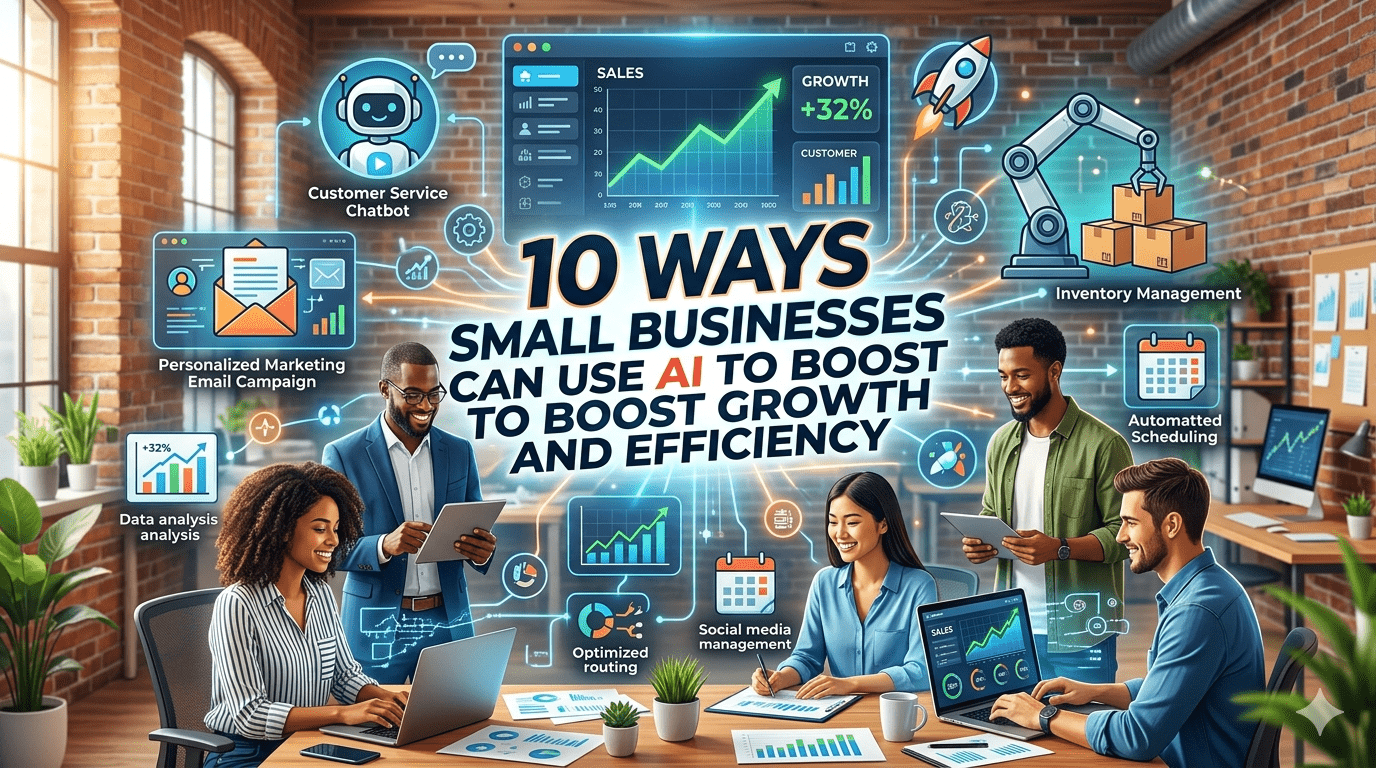
10 Ways Small Businesses Can Use AI to Boost Growth and Efficiency

10 Ways Small Businesses Can Use AI to Boost Growth and Efficiency

In today’s rapidly evolving digital landscape, artificial intelligence (AI) is no longer reserved for large enterprises with massive budgets. Small businesses now have access to powerful, affordable AI tools that can transform operations, increase efficiency, and drive measurable growth.

From automating repetitive tasks to delivering personalized customer experiences, AI empowers small businesses to compete at a higher level—without dramatically increasing overhead.

This guide explores 10 high-impact ways small businesses can use AI, along with actionable strategies for implementation, real-world applications, and best practices for maximizing ROI.

How Small Businesses Can Implement AI Effectively

Understanding the Basics of AI Technology

Artificial intelligence refers to systems that can analyze data, learn patterns, and make decisions with minimal human intervention. Core components include:

  • Machine Learning (ML): Learns from historical data to predict outcomes
  • Natural Language Processing (NLP): Enables chatbots, voice assistants, and text analysis
  • Predictive Analytics: Forecasts trends based on data patterns
  • Automation Algorithms: Replace manual, repetitive processes

For small businesses, the focus should be on practical application, not technical complexity. The goal is to use AI to save time, reduce costs, and improve decision-making.

Choosing the Right AI Tools for Your Business

Selecting the right tools is critical. Focus on solutions that:

  • Solve a specific operational problem
  • Integrate with existing systems (CRM, website, POS)
  • Offer scalability as your business grows
  • Provide ease of use and onboarding support

Common entry-level AI tools include:

  • Chatbots for customer service
  • Email marketing automation platforms
  • CRM systems with AI insights
  • Inventory forecasting software

Steps for Successful AI Implementation

  1. Identify inefficiencies or bottlenecks
  2. Define clear KPIs (time saved, revenue growth, etc.)
  3. Start with one use case (pilot program)
  4. Train your team on tool usage
  5. Track performance and optimize continuously

Businesses that take a phased approach see faster adoption and stronger ROI.

What Are the Benefits of Using AI in Business?

Enhancing Customer Experience

AI allows businesses to deliver personalized, real-time interactions at scale. Examples include:

  • Chatbots providing instant support
  • Product recommendations based on browsing behavior
  • Automated follow-ups and reminders

This level of responsiveness improves:

  • Customer satisfaction
  • Retention rates
  • Conversion rates

Increasing Efficiency Through Automation

AI eliminates time-consuming manual tasks such as:

  • Data entry
  • Appointment scheduling
  • Invoice processing
  • Lead routing

This allows teams to focus on:

  • Revenue-generating activities
  • Strategic planning
  • Customer relationship building

Data-Driven Decision Making

AI transforms raw data into actionable insights. Instead of guessing, businesses can:

  • Identify top-performing products/services
  • Predict customer behavior
  • Optimize pricing strategies
  • Improve marketing ROI

10 Practical Ways Small Businesses Can Use AI

1. AI-Powered Customer Service (Chatbots & Virtual Assistants)

AI chatbots can handle:

  • FAQs
  • Appointment booking
  • Order tracking
  • Lead qualification

Impact:

  • 24/7 availability
  • Reduced support costs
  • Faster response times

2. Smart Marketing Automation

AI enhances marketing by:

  • Segmenting audiences automatically
  • Personalizing email campaigns
  • Optimizing ad targeting in real-time

Result: Higher engagement and conversion rates with less manual effort.

3. Predictive Analytics for Sales Growth

AI analyzes past behavior to predict:

  • Which leads are most likely to convert
  • When customers are ready to buy
  • Which products will perform best

This allows for proactive sales strategies instead of reactive ones.

4. Content Creation and Optimization

AI tools can assist with:

  • Blog writing
  • Social media captions
  • Ad copy
  • SEO optimization

Small businesses can maintain a consistent content strategy without a large marketing team.

5. AI-Driven SEO Strategy

AI helps improve search visibility by:

  • Identifying keyword opportunities
  • Analyzing competitor content
  • Optimizing on-page SEO
  • Structuring content for AI search results (AEO)

This is critical as search behavior shifts toward AI-generated answers and voice search.

6. Inventory Management and Demand Forecasting

AI systems analyze:

  • Historical sales data
  • Seasonal trends
  • Customer demand patterns

Benefits:

  • Reduced overstock and stockouts
  • Improved cash flow
  • Better supply chain efficiency

7. Automated Financial Management

AI tools can streamline:

  • Bookkeeping
  • Expense tracking
  • Fraud detection
  • Financial forecasting

This reduces human error and provides real-time financial visibility.

8. AI in Hiring and HR Processes

AI can assist with:

  • Resume screening
  • Candidate matching
  • Interview scheduling
  • Employee performance tracking

This shortens hiring cycles and improves candidate quality.

9. Personalized Customer Experiences

AI enables hyper-personalization by analyzing:

  • Purchase history
  • Website behavior
  • Engagement patterns

Examples include:

  • Personalized product recommendations
  • Dynamic website content
  • Targeted promotions

10. Business Process Automation

AI can streamline entire workflows, including:

  • Lead management pipelines
  • CRM updates
  • Internal communications
  • Reporting and analytics

This creates a more agile and scalable business operation.

How AI Technology Transforms Business Processes

Automating Repetitive Tasks

AI reduces the need for manual intervention in routine operations. This leads to:

  • Increased productivity
  • Lower labor costs
  • Faster execution

Machine Learning Applications in Business

Machine learning continuously improves performance by learning from data. Common applications include:

  • Sales forecasting
  • Customer churn prediction
  • Risk analysis

Over time, systems become more accurate and valuable.

AI-Powered Analytics for Competitive Advantage

AI analytics tools provide:

  • Real-time dashboards
  • Predictive insights
  • Performance benchmarking

Businesses can make faster, smarter decisions with confidence.

Challenges of Using AI in Small Businesses

Overcoming Resistance to Adoption

Common concerns include:

  • Fear of job replacement
  • Lack of technical knowledge
  • Uncertainty about ROI

Solution: Provide training, emphasize augmentation (not replacement), and demonstrate quick wins.

Budget Considerations

While AI is more accessible than ever, costs still matter. Best practices include:

  • Start with low-cost tools
  • Focus on high-impact use cases
  • Scale gradually based on ROI

Data Privacy and Security

AI relies on data—making compliance essential.

Businesses must ensure:

  • Secure data storage
  • Transparent data usage
  • Compliance with regulations (GDPR, CCPA)

This builds trust and protects brand reputation.

Why Work with The AD Leaf Marketing Firm?

At The AD Leaf ® Marketing Firm, we specialize in helping small businesses leverage AI to drive measurable growth.

What Sets Us Apart:

  • Custom AI-driven marketing strategies tailored to your business
  • SEO + AEO optimization for modern search visibility
  • Advanced automation systems to streamline operations
  • Full-service digital marketing support (web, social, paid ads, content)

We understand that business owners don’t have time to manage multiple platforms, optimize content, and analyze data simultaneously. That’s why we build integrated, scalable systems that work together to generate leads and increase efficiency.

Getting Started with AI in Your Business

If you’re new to AI, start with these steps:

  1. Identify one area of inefficiency
  2. Implement a simple AI tool (chatbot, automation, etc.)
  3. Measure results within 30–60 days
  4. Expand into additional areas based on success

The key is progress over perfection—small improvements compound quickly.

Frequently Asked Questions (FAQ)

What is the best AI tool for small businesses?

The best tool depends on your needs. Common starting points include:

  • Chatbots for customer service
  • CRM platforms with AI insights
  • Email marketing automation tools

Is AI expensive for small businesses?

No. Many AI tools offer affordable pricing tiers or free versions. The key is choosing tools that deliver clear ROI.

Can AI replace employees?

AI is best used to augment employees, not replace them. It handles repetitive tasks, allowing teams to focus on higher-value work.

How quickly can businesses see results from AI?

Many businesses see measurable improvements within 30–90 days, especially in areas like marketing automation and customer service.

How does AI improve marketing performance?

AI improves marketing by:

  • Targeting the right audience
  • Personalizing messaging
  • Optimizing campaigns in real time
  • Increasing conversion rates

Final Thoughts

Artificial intelligence is no longer a future concept—it’s a present-day competitive advantage. Small businesses that adopt AI strategically can:

  • Operate more efficiently
  • Make smarter decisions
  • Deliver better customer experiences
  • Scale faster with fewer resources

By starting small and focusing on high-impact applications, any business can unlock the power of AI.

Looking to integrate AI into your marketing and operations?

The AD Leaf Marketing Firm can help you build and implement a customized AI-driven strategy designed to generate leads, increase efficiency, and accelerate growth.

Contact us today to schedule a consultation and discover how AI can transform your business.

Nvidia NemoClaw Launch: Open-Source AI Agent Platform Based on OpenClaw

AI Daily Update: Nvidia Launches NemoClaw: Open-Source AI Agent Platform Based on OpenClaw

Nvidia Launches NemoClaw: Open-Source AI Agent Platform Based on OpenClaw

Businesses are constantly seeking innovative solutions to enhance their operations and stay ahead of the competition. Recognizing this need, Nvidia is planning to launch an open-source AI agent platform based on OpenClaw, named Nvidia NemoClaw. This cutting-edge platform promises to revolutionize the way AI is integrated into various industries, offering unprecedented levels of autonomy and efficiency. Stay tuned as we dive deep into what Nvidia’s NemoClaw has to offer and how it might impact the future of AI.

Key Takeaways:

  • Nvidia NemoClaw is an open-source AI agent platform built on OpenClaw, designed to enhance AI integration across industries.
  • The launch of NemoClaw will include comprehensive support for developers and users, ensuring smooth adoption and effective utilization.
  • NemoClaw distinguishes itself through advanced privacy and security guardrails, setting it apart from other open-source AI solutions.
  • The AD Leaf Marketing Firm can assist businesses in leveraging Nvidia NemoClaw to create scalable, results-driven AI marketing solutions.

If you’re looking to harness the power of AI to transform your marketing efforts, The AD Leaf Marketing Firm is here to help. As experts in digital and AI marketing, we can guide you through the complexities of AI integration and develop strategies that drive tangible results. Contact us today to learn more about how we can help you leverage AI for your business!

What is Nvidia NemoClaw and How Does it Relate to OpenClaw?

Nvidia NemoClaw is an innovative AI agent platform designed to empower developers and businesses with advanced AI capabilities. This open-source AI agent platform is built upon the foundation of OpenClaw, leveraging its architecture to create autonomous AI agents that can perform a wide range of tasks. This platform represents Nvidia’s commitment to advancing the field of AI by providing accessible and powerful tools for developers to build and deploy intelligent applications.

Overview of Nvidia NemoClaw

Nvidia NemoClaw represents a significant advancement in AI technology, offering a comprehensive suite of tools for creating and managing AI agents. This open-source AI agent platform is designed to be versatile, catering to a wide array of applications from coding agent assistants to complex autonomous systems. With the backing of Nvidia’s robust infrastructure, NemoClaw promises to deliver unparalleled performance and scalability, making it an ideal choice for developers looking to leverage the power of AI.

Understanding OpenClaw in the Context of AI

OpenClaw serves as the foundational framework upon which Nvidia NemoClaw is built. It provides the basic architecture and principles for creating AI agents capable of autonomous decision-making and task execution. In the context of AI, OpenClaw enables the development of agentic AI systems that can interact with their environment, learn from experience, and adapt to changing conditions. By leveraging OpenClaw, Nvidia aims to democratize access to advanced AI capabilities, fostering innovation across various industries.

Key Features of the Open-Source AI Agent Platform

Nvidia NemoClaw boasts a range of key features that set it apart as a leading AI agent platform. Specifically, the platform offers:

  • A modular design for easy customization.
  • Robust support for various AI models and frameworks.

Beyond these core elements, NemoClaw also provides advanced tools for managing the behavior and interactions of AI agents. Furthermore, NemoClaw incorporates privacy and security guardrails to ensure responsible AI development and deployment, addressing growing concerns around ethical AI practices. These features collectively make NemoClaw a powerful and versatile platform for building the next generation of AI applications.

How is Nvidia Planning to Launch the Open-Source AI Agent Platform?

Nvidia is planning to launch the open-source AI agent platform, NemoClaw, with a well-structured strategy aimed at maximizing its impact and adoption. The launch will involve several key phases, including an initial release of the core platform, followed by ongoing updates and enhancements based on community feedback. Nvidia is also planning to launch a comprehensive set of resources, including documentation, tutorials, and developer tools, to support users in building and deploying AI agents on the platform. This strategic approach underscores Nvidia’s commitment to fostering a vibrant ecosystem around NemoClaw.

Timeline for the Launch of NemoClaw

The timeline for the launch of Nvidia’s NemoClaw is anticipated to unfold in several stages. Initially, a beta version will be released to select developers and partners for testing and feedback. Following this, a broader public release is planned, accompanied by extensive documentation and support resources. Nvidia CEO Jensen Huang is expected to highlight NemoClaw at upcoming GTC conferences, providing further details on the launch timeline and key features. This phased approach ensures a smooth and well-supported rollout of the open-source AI agent platform.

What to Expect from Nvidia’s Launch Strategy

Nvidia’s launch strategy for NemoClaw is expected to focus on accessibility, scalability, and security and privacy. The company will likely emphasize the open-source nature of the platform, encouraging community contributions and collaboration. Additionally, Nvidia is expected to showcase the platform’s ability to handle complex AI workloads, highlighting its potential for enterprise applications. Security and privacy guardrails will also be a key focus, addressing concerns around data protection and responsible AI development. By emphasizing these aspects, Nvidia aims to position NemoClaw as a trusted and reliable AI agent platform.

How Nvidia Plans to Support Developers and Users

Nvidia recognizes the importance of providing comprehensive support to developers and users of the NemoClaw AI agent platform. To this end, the company is planning to offer a range of resources, including detailed documentation, sample code, and community forums. Additionally, Nvidia will likely host workshops and training sessions to help developers get up to speed with the platform. By fostering a supportive ecosystem, Nvidia aims to empower developers to build innovative AI applications and contribute to the ongoing development of NemoClaw. This comprehensive support strategy will be critical to the success of the platform.

What Makes NemoClaw a Unique AI Agent Platform?

Nvidia NemoClaw distinguishes itself from other AI agent platforms through its unique combination of features, performance, and security. Built on the foundation of OpenClaw, NemoClaw offers a robust and scalable architecture for developing autonomous AI agents. The platform’s emphasis on privacy and security guardrails sets it apart, addressing growing concerns around responsible AI development. Additionally, NemoClaw’s integration with Nvidia’s hardware and software ecosystem provides unparalleled performance and efficiency, making it a compelling choice for developers looking to build cutting-edge AI applications.

Comparison with Other Open-Source AI Solutions

When compared to other open-source AI solutions, Nvidia NemoClaw stands out due to its focus on creating autonomous AI agents with enhanced privacy and security features. While many open-source platforms offer tools for building AI models, NemoClaw goes further by providing a comprehensive framework for managing the behavior and interactions of AI agents. Additionally, NemoClaw benefits from Nvidia’s extensive hardware and software expertise, ensuring optimal performance and scalability. This combination of features makes NemoClaw a unique and powerful platform for developing advanced AI applications.

Privacy and Security Guardrails in NemoClaw

Privacy and security are paramount in the design of Nvidia NemoClaw. The platform incorporates robust guardrails to protect sensitive data and ensure responsible AI development. These guardrails include mechanisms for controlling data access, monitoring agent behavior, and preventing unauthorized actions. Additionally, NemoClaw supports secure communication protocols and encryption to safeguard data in transit and at rest. By prioritizing privacy and security, Nvidia aims to build trust and confidence in the platform, encouraging widespread adoption and responsible use of AI technology.

The Role of OpenClaw Agents in Enhancing Functionality

OpenClaw agents play a crucial role in enhancing the functionality of Nvidia NemoClaw. These agents are designed to be autonomous, intelligent, and capable of performing a wide range of tasks without human intervention. By leveraging OpenClaw’s architecture, developers can create agents that can learn from experience, adapt to changing conditions, and make informed decisions. This results in AI applications that are more efficient, reliable, and capable of delivering real-world value. The integration of OpenClaw agents is a key differentiator for NemoClaw, enabling it to tackle complex AI challenges with ease.

How to Get Started with Nvidia NemoClaw?

Installation Process for Developers

To begin with Nvidia NemoClaw, developers need to follow a specific installation process. This typically involves downloading the necessary packages and libraries from Nvidia’s official repositories. As an open-source AI agent platform, NemoClaw requires a compatible development environment, which may include setting up CUDA drivers and other AI tools necessary for leveraging Nvidia hardware. The installation process is crucial for utilizing the full potential of the AI agent capabilities.

Setting Up Your First OpenClaw AI Agent

Setting up your first OpenClaw AI agent on the Nvidia NemoClaw platform involves several key steps. First, you need to define the purpose and functionality of the agent. Then, you can use the provided APIs and tools to configure the agent’s behavior, integrating various AI models and algorithms. This process allows you to create autonomous AI agents tailored to specific tasks, ensuring that they can effectively perform their assigned functions within your applications.

Best Practices for Using the AI Agent Platform

To maximize the effectiveness of the Nvidia NemoClaw AI agent platform, several best practices should be followed. These practices are crucial for developing reliable and efficient agents and include:

  • Designing agents with clear, specific goals.
  • Implementing robust error handling.
  • Continuously monitoring their performance.

Also, regularly updating the AI models and algorithms used by the agents is important to maintain accuracy and relevance. By adhering to these best practices, developers can ensure that their AI agents are reliable, efficient, and secure.

OpenClaw Vs Claude Code Vs NemoClaw

Building Autonomous AI Agents

When building autonomous AI agents, Nvidia NemoClaw offers unique advantages over platforms like Claude Code. NemoClaw is designed as an open-source AI agent platform, it provides developers with greater flexibility and control over the AI models and algorithms used. This allows for more customization and optimization compared to closed-source solutions. The ability to build agentic AI systems from the ground up is a key differentiator, empowering developers to create truly autonomous and intelligent agents.

Why Choose Nvidia as Your Partner in Open-Source AI Development?

The Expertise of The AD Leaf Marketing Firm

The AD Leaf Marketing Firm offers unparalleled expertise in leveraging Nvidia’s AI technologies, including the NemoClaw open-source AI agent platform. As specialists in digital and AI marketing, they can guide businesses in integrating these cutting-edge tools into their marketing strategies. The AD Leaf helps organizations harness the power of autonomous AI agents to drive growth and improve efficiency.

Benefits of Collaborating with Nvidia for AI Projects

Collaborating with Nvidia for AI projects offers numerous benefits, including access to state-of-the-art hardware, software, and support resources. Nvidia’s commitment to advancing AI technology is evident in platforms like NemoClaw, which provides developers with the tools they need to build innovative AI applications. By partnering with Nvidia, businesses can accelerate their AI development efforts and gain a competitive edge in the market. The launch of such AI Agent platform can improve marketing capabilities through the use of AI.

Future of Open-Source AI with Nvidia

The future of open-source AI looks promising with Nvidia leading the charge. The launch of the NemoClaw open-source AI agent platform signifies Nvidia’s commitment to democratizing access to AI technology. By fostering a collaborative ecosystem, Nvidia aims to drive innovation and accelerate the development of AI applications across various industries. This vision positions Nvidia as a key player in shaping the future of AI, empowering developers and businesses alike. Nvidia is planning to launch an open-source AI agent platform to enhance collaboration.

Key Takeaways from the Nvidia NemoClaw Launch

Summary of Major Points

The Nvidia NemoClaw launch signifies a major advancement in the field of AI, offering an open-source AI agent platform built on OpenClaw. This platform aims to empower developers to create autonomous AI agents that can revolutionize various industries. The Nvidia AI platform integrates advanced security and privacy guardrail features, setting it apart from other open-source AI solutions.

Importance of Open-Source in AI Development

The open-source nature of Nvidia NemoClaw is vital for fostering innovation and collaboration in AI development. By providing developers with access to the underlying code and architecture, Nvidia encourages community contributions and the creation of customized AI solutions. This collaborative approach accelerates the development of AI agent platforms and ensures that AI technology is accessible to a wider audience, improving overall AI understanding.

Looking Ahead: The Future of AI Agents

The future of AI agents looks promising, with Nvidia’s NemoClaw playing a key role in driving advancements. As developers leverage the open-source AI agent platform to build more sophisticated and autonomous AI agents, we can expect to see AI transforming various aspects of our lives. From coding agent assistants to AI assistant applications, the possibilities are vast and the potential impact is significant.

Frequently Asked Questions About Nvidia NemoClaw

What types of businesses can benefit most from Nvidia NemoClaw?

Businesses across various sectors, including technology, finance, healthcare, and manufacturing, can leverage Nvidia NemoClaw to enhance their AI capabilities and automate complex tasks. The platform’s versatility and scalability make it suitable for both small startups and large enterprises looking to integrate AI into their operations.

How does NemoClaw ensure data privacy and security in AI applications?

NemoClaw incorporates advanced privacy and security guardrails, including secure communication protocols, encryption, and mechanisms for controlling data access. These features help protect sensitive data and ensure responsible AI development, addressing growing concerns around data privacy and security.

What level of coding expertise is required to use Nvidia NemoClaw effectively?

While some coding knowledge is beneficial, NemoClaw is designed to be accessible to developers with varying levels of expertise. The platform offers detailed documentation, sample code, and developer tools to help users get started, making it easier to build and deploy AI agents.

How can The AD Leaf Marketing Firm assist in implementing Nvidia NemoClaw for marketing purposes?

The AD Leaf Marketing Firm specializes in digital and AI marketing, providing expert guidance and support for businesses looking to leverage AI to enhance their marketing efforts. We can help you develop AI-driven marketing strategies, implement NemoClaw, and optimize your campaigns for maximum impact.

What are the key advantages of using an open-source AI agent platform like NemoClaw?

Open-source AI agent platforms like NemoClaw offer numerous advantages, including increased transparency, community support, and the ability to customize the platform to meet specific business needs. Additionally, open-source platforms often benefit from ongoing improvements and enhancements contributed by a global community of developers.

How does Nvidia plan to monetize NemoClaw given that it’s an open-source platform?

While NemoClaw is open-source, Nvidia can monetize it through various avenues such as offering premium support services, enterprise-level features, and integration with its proprietary hardware and software ecosystem. This allows developers to use the core platform for free while providing Nvidia with opportunities to generate revenue from value-added services.

What is the main purpose of Nvidia NemoClaw?

The primary purpose of Nvidia NemoClaw is to provide an open-source AI agent platform that enables developers to create, deploy, and manage autonomous AI agents. This platform is built on OpenClaw and aims to facilitate the development of AI applications across various industries. With the launch, Nvidia is planning to democratize access to advanced AI capabilities.

How does NemoClaw ensure privacy and security?

NemoClaw incorporates robust privacy and security guardrail measures to protect sensitive data and ensure responsible AI development. These measures include secure communication protocols, encryption, and access controls. By prioritizing security and privacy, Nvidia aims to build trust in the platform and encourage its responsible use. The platform offers a secure version of OpenClaw to further enhance the security.

What are the primary features of OpenClaw AI Agents?

OpenClaw AI Agents are designed to be autonomous, intelligent, and capable of performing a wide range of tasks without human intervention. These agents can learn from experience, adapt to changing conditions, and make informed decisions. They boast several key features, including:

  • A modular design
  • Support for various AI models
  • Advanced tools for managing agent behavior

These capabilities enable the creation of advanced agentic AI systems.

Can businesses leverage Nvidia NemoClaw for their operations?

Yes, businesses can leverage Nvidia NemoClaw to enhance their operations by integrating autonomous AI agents into various processes. This can lead to increased efficiency, improved decision-making, and new revenue streams. NemoClaw is designed to be versatile and scalable, making it suitable for both small startups and large enterprises. This launch enhances the capabilities of AI tools.

What types of projects are ideal for Nvidia’s open-source platform?

Ideal projects for Nvidia’s open-source AI agent platform include those that require autonomous decision-making, task automation, and intelligent interaction with the environment. Examples include coding agent assistants, customer service bots, and autonomous robotic systems. The platform’s flexibility and scalability make it suitable for a wide range of AI applications. Nvidia is planning to launch an open-source AI agent platform for various projects.

How can I get support for using Nvidia NemoClaw?

To get support for using Nvidia NemoClaw, developers can access a range of resources, including detailed documentation, sample code, and community forums. Additionally, Nvidia may offer workshops and training sessions to help developers get up to speed with the platform. The AD Leaf Marketing Firm can also provide expert guidance and support for businesses looking to implement NemoClaw effectively, especially for AI agent related tasks.

AI Daily Update: Amazon and Pinterest Are Reshaping Product Discovery

AI Daily Update: Amazon and Pinterest Are Reshaping Product Discovery

The way consumers discover and purchase products online is changing quickly. For years, most businesses focused their digital marketing strategy on ranking in Google search results. Today, however, discovery happens across many platforms, many of which are powered by artificial intelligence.

One of the most important shifts happening right now involves the growing partnership between Amazon and Pinterest. Together, these two platforms are creating a powerful ecosystem where AI‑driven discovery meets frictionless purchasing.

Understanding how these platforms interact is becoming critical for businesses that want to stay visible in modern search and discovery environments.

Why Pinterest Has Become a Discovery Engine

Pinterest has evolved far beyond a simple social media platform. Today it functions more like a visual search engine where users actively look for ideas, inspiration, and future purchases.

People commonly use Pinterest when planning:

  • home renovations
  • fashion purchases
  • weddings and events
  • recipes and lifestyle changes
  • product ideas and inspiration

Pinterest’s artificial intelligence analyzes images, engagement behavior, saved boards, and topic clusters to determine what users are most likely interested in discovering next.

This allows Pinterest to surface highly relevant content and product recommendations before a user even begins actively searching for a specific item.

How Amazon Enters the Equation

Amazon has partnered with Pinterest to place product ads directly within Pinterest feeds. When users click on these recommendations, they can purchase the product directly through Amazon.

This creates a seamless discovery‑to‑purchase journey:

Pinterest Inspiration → AI Recommendation → Amazon Purchase

Amazon contributes product catalog data, pricing, fulfillment logistics, and purchasing behavior insights. Pinterest contributes discovery data, visual search signals, and early‑stage consumer intent.

Together, the two platforms create an extremely efficient AI‑powered commerce funnel.

Why This Matters for Businesses

Consumers are no longer beginning every journey on Google. Instead, they start wherever their intent naturally lives. Someone ready to buy may go directly to Amazon. Someone looking for inspiration may open Pinterest. Someone researching a service may use Google or an AI assistant.

Modern marketing strategies must adapt to these shifting discovery behaviors. Businesses that understand how to position their content across discovery platforms will have a major advantage as AI search continues evolving.

The Future of AI‑Driven Discovery

The partnership between Amazon and Pinterest is just one example of how AI is transforming digital marketing. In the near future, consumers will increasingly rely on AI systems to help them discover products, evaluate options, and make purchasing decisions.

Brands that invest early in AI search optimization, content authority, and multi‑platform discovery strategies will be far more likely to capture attention in this new environment.

Why This Matters for Businesses in Corporate

For companies working with a digital marketing agency in Corporate, understanding AI‑driven discovery platforms is becoming essential. Businesses that optimize their content for AI search engines, visual discovery platforms, and answer engines will have a competitive advantage.

Ready to future‑proof your marketing strategy for AI search and discovery?

The AD Leaf Marketing Firm helps businesses stay visible in the evolving world of AI search, answer engines, and multi‑platform discovery. Our team specializes in SEO, AEO (Answer Engine Optimization), and AI‑driven marketing strategies designed to help brands appear where modern consumers are actually searching.

If you’re ready to improve your visibility across Google, AI search platforms, and emerging discovery engines, contact The AD Leaf today to schedule a strategy session.

AI Coding tools, OpenClaw, ClawCamp, ai software developers

Effective Marketing Strategies for AI Software Developers

Effective Marketing Strategies for AI Software Developers

Marketing your AI software effectively requires a strategic approach that leverages the very technology you’re promoting. With the increasing adoption of artificial intelligence across various industries, developers need to employ innovative marketing strategies to stand out. This guide provides actionable insights into how to market your AI software, ensuring it reaches the right audience and achieves market success. Consider leveraging a marketing partner like The AD Leaf for assistance.

Key Takeaways

  • Understanding the transformative power of AI in marketing is crucial for effectively promoting AI software.
  • AI automation offers significant benefits to marketing teams, streamlining processes and enhancing productivity.
  • Integrating AI into existing marketing strategies can drive more targeted and efficient campaigns.
  • The future of AI in marketing promises even more sophisticated tools and capabilities, requiring continuous adaptation and innovation.

Understanding AI in Marketing

What is AI and How is it Transforming Marketing?

Artificial intelligence is revolutionizing marketing by offering tools and capabilities that were once unimaginable. AI models are being used to analyze vast amounts of data, predict consumer behavior, and personalize marketing messages. This transformation allows marketers to make data-driven decisions, optimize marketing campaigns in real-time, and deliver highly targeted content to potential customers. The use of AI in marketing is not just a trend; it’s a fundamental shift in how businesses connect with their audience and drive growth. This includes everything from enhancing email marketing campaigns to developing more engaging content marketing strategies.

Why Choose an AI Marketing Agency | The AD Leaf

Selecting the right partner to navigate the complexities of AI marketing is crucial, and The AD Leaf stands out as an ideal choice. With expertise in both digital marketing and artificial intelligence, The AD Leaf offers tailored solutions that leverage AI capabilities to enhance your marketing efforts. They understand how to use AI tools to automate marketing tasks, improve lead generation, and optimize your marketing spend. Choosing The AD Leaf means gaining a competitive edge by effectively integrating AI into your marketing strategy, driving better results and achieving your business goals. Contact The AD Leaf today to discuss your specific needs and discover how their AI-powered marketing solutions can transform your business.

How Does AI Automation Benefit Marketing Teams?

AI automation is transforming marketing teams by streamlining processes and boosting efficiency. By automating repetitive marketing tasks, such as data analysis, email marketing, and social media management, AI frees up marketers to focus on more strategic initiatives. AI-powered marketing tools can also personalize customer experiences at scale, delivering targeted content and offers based on individual preferences. The benefits of AI automation extend to improved lead generation, enhanced customer engagement, and increased ROI on marketing campaigns. Leveraging AI helps marketing teams achieve more with less, driving significant improvements in overall performance.

Ways to Use AI in Your Marketing Strategy

How to Leverage AI Tools for Enhanced Marketing Results

To leverage AI tools effectively and enhance marketing results, marketers should first identify areas where AI can help automate and improve efficiency. AI automation can streamline repetitive marketing tasks, allowing marketing teams to focus on strategic initiatives. AI models can analyze customer data to personalize marketing campaigns, improving engagement and conversion rates. By integrating AI capabilities into existing marketing strategies, businesses can achieve better ROI and drive growth. Using AI in marketing is about finding the right AI tools and implementing them strategically to maximize their impact.

Best AI Tools for Marketing: A Comprehensive Guide

A comprehensive guide to the best AI tools for marketing includes a range of options to enhance marketing efforts across various channels. AI chatbots can improve customer service by providing instant support and personalized recommendations. AI-powered marketing software can automate email marketing campaigns, delivering targeted content to specific customer segments. Generative AI tools can assist in AI content creation, producing engaging blog posts and social media updates. By exploring and implementing the right AI marketing tool, marketers can optimize their marketing stack and drive better results. Finding a good AI tool can be the difference in a great campaign.

Using AI Assistants to Streamline Marketing Workflows

Using AI assistants can significantly streamline marketing workflows by automating various tasks and providing valuable insights. AI assistants can help with data analysis, market trends identification, and campaign optimization. These AI agents can also assist in content creation and curation, ensuring that marketing messages are relevant and engaging. By leveraging AI assistants, marketing teams can improve efficiency, reduce errors, and free up time for more strategic activities. AI integration into existing marketing processes is key to unlocking the full potential of AI and achieving better results. This tool like this can help enhance any campaign.

Implementing AI-Powered Marketing Techniques

How to Create Effective AI Marketing Campaigns

Creating effective AI marketing campaigns involves several key steps. The initial stages often include:

  • Defining clear objectives and identifying the target audience.
  • Selecting the appropriate AI marketing tool and AI platform that align with your goals.

AI can then help analyze data, segment audiences, and personalize marketing messages. Implement AI automation to streamline repetitive tasks and improve efficiency, and continuously monitor and optimize the AI marketing campaign based on performance metrics. By following these steps, marketers can create impactful AI-powered marketing campaigns that drive results. By using AI in marketing campaigns, the marketing and sales teams can increase revenue.

Use Cases: Successful AI Marketing Implementations

Successful AI marketing implementations span various industries and use cases. In e-commerce, AI models are used to personalize product recommendations and optimize pricing strategies. In healthcare, AI chatbots provide patient support and appointment scheduling. In finance, AI is used for fraud detection and risk management. These use cases demonstrate the transformative power of AI in marketing and highlight the potential for businesses to achieve significant improvements in efficiency, customer engagement, and ROI. These real-world examples show how AI is not just a theoretical concept, but a practical solution for driving business success.

Future of AI in Marketing: Trends and Predictions

The future of AI in marketing promises even more sophisticated tools and capabilities. AI technology continues to evolve. One trend is the increased use of AI agents that can autonomously manage marketing campaigns. Another is the development of more personalized customer experiences through AI-driven insights. Predictive analytics will become more accurate, enabling marketers to anticipate customer needs and behaviors. As AI becomes more integrated into marketing strategies, businesses that embrace AI will gain a significant competitive advantage. By staying informed about these trends and predictions, marketers can prepare for the future and leverage AI to drive growth. Different marketing channels could all use AI.

Key Considerations for AI Marketing

What Makes a Good AI Marketing Tool?

A good AI marketing tool should offer a combination of features that enhance efficiency, improve targeting, and provide actionable insights. It should be able to automate repetitive marketing tasks, freeing up marketers to focus on strategic initiatives. The AI tool should also provide advanced analytics capabilities, allowing marketers to track performance metrics and optimize campaigns in real-time. A good AI marketing tool should seamlessly integrate with existing marketing software and platforms, ensuring a smooth and efficient workflow. It should also be user-friendly, with an intuitive interface that allows marketers to easily access and use its features.

How to Evaluate AI Marketing Tools for Your Business

Evaluating AI marketing tools for your business requires a strategic approach to ensure the selected tools meet your specific needs and objectives. Begin by identifying the marketing challenges you want to solve with AI technology, such as improving lead generation or enhancing customer engagement. Assess the AI capabilities of each tool, including its ability to automate tasks, analyze data, and personalize marketing messages. Consider the integration of each tool with your existing marketing stack and ensure it aligns with your overall marketing strategy. Also consider the AI marketing tool cost and the level of support provided.

Common Pitfalls to Avoid When Using AI in Marketing

When using AI in marketing, it’s important to avoid common pitfalls that can undermine the effectiveness of your campaigns. One pitfall is relying too heavily on AI automation without human oversight, which can lead to errors and missed opportunities. Another is neglecting data quality, as AI models require accurate and up-to-date data to function effectively. Also, when you use AI, be sure that you monitor it to avoid biased algorithms, which can result in unfair or discriminatory outcomes. Avoid overlooking the importance of ethical considerations, such as data privacy and transparency. By being aware of these pitfalls and taking steps to avoid them, marketers can harness the full potential of AI in marketing.

Key Takeaways

Summarizing the Importance of AI in Marketing

The importance of AI in marketing cannot be overstated, as it offers transformative capabilities that can drive significant improvements in efficiency, targeting, and ROI. AI can automate repetitive tasks, freeing up marketers to focus on strategic initiatives. AI technology enables marketers to personalize customer experiences at scale, delivering targeted content and offers based on individual preferences. By integrating AI into existing marketing strategies, businesses can achieve better results and gain a competitive edge. Embracing AI in marketing is essential for staying ahead in today’s rapidly evolving digital landscape, and those who leverage AI solutions effectively will see the greatest rewards.

Four Vital Points to Remember About AI Marketing Strategies

Implementing AI marketing strategies requires careful consideration. To maximize your success, focus on these key elements:

  1. Define clear objectives and align your AI initiatives with your overall marketing goals.
  2. Prioritize data quality and ensure that your AI models have access to accurate and up-to-date data.
  3. Embrace AI automation to streamline repetitive tasks and improve efficiency, but maintain human oversight to ensure ethical and accurate outcomes.
  4. Continuously monitor and optimize your AI marketing campaigns based on performance metrics, making adjustments as needed to achieve the best results.

By keeping these points in mind, you can effectively leverage AI to drive growth and achieve your marketing objectives.

Why Partnering with The AD Leaf Marketing Firm is Essential

Partnering with The AD Leaf Marketing Firm is essential because they bring specialized expertise in both digital marketing and artificial intelligence. The AD Leaf understands how to use AI capabilities to enhance marketing efforts, offering tailored solutions that drive better results. With their assistance, businesses can effectively integrate AI into their marketing strategy, improving lead generation, enhancing customer engagement, and optimizing marketing spend. The AD Leaf provides the knowledge and experience needed to navigate the complexities of AI marketing and achieve your business goals. With a partner like The AD Leaf, you are not just adopting AI, you’re gaining a competitive edge and a future-proof marketing strategy.

Frequently Asked Questions

How can AI make my marketing campaigns more effective?

AI can analyze data to understand customer behavior, predict trends, and automate personalized marketing messages, leading to higher engagement and conversion rates.

What are some practical ways to use AI in marketing today?

Practical use cases include AI chatbots for customer service, AI-powered content creation, predictive analytics for sales forecasting, and AI-driven email marketing automation.

Which types of businesses benefit most from AI marketing strategies?

Businesses with large datasets, extensive customer interactions, and complex marketing operations can benefit most from AI marketing strategies, regardless of industry.

What are the limitations of using AI in marketing?

Limitations include the need for high-quality data, the potential for biased algorithms, and the importance of maintaining human oversight to ensure ethical and accurate marketing practices.

How does AI content generation improve marketing efforts?

AI content generation tools can quickly produce blog posts, social media updates, and other marketing materials, freeing up marketers to focus on strategy and creativity while maintaining a consistent brand voice.

What is the future of AI in digital marketing?

The future of AI in digital marketing involves more sophisticated AI agents, personalized customer experiences, and automated decision-making processes, ultimately transforming how businesses connect with their audience and drive growth.

What are the best AI marketing tools available today?

Discovering the best AI marketing tools available involves identifying solutions that can significantly enhance your marketing efforts. Many AI tool options exist, including AI automation platforms, AI-powered marketing software, and AI-driven analytics tools. These tools can help automate marketing tasks, personalize customer experiences, and provide valuable insights into campaign performance. When selecting the best AI marketing tool, consider your specific needs and objectives, such as improving lead generation, enhancing customer engagement, or optimizing marketing spend. AI helps improve marketing and sales.

How can AI improve my marketing and sales efforts?

AI can transform marketing and sales efforts by providing automation and insights that were once unattainable. By using AI marketing strategies, you can analyze data to understand customer behavior, predict trends, and personalize marketing messages. AI can help automate repetitive tasks such as email marketing, social media management, and data analysis. This automation frees up your marketing team to focus on more strategic initiatives. Implementing AI also improves lead generation, customer engagement, and overall marketing ROI, driving significant improvements in your business performance. This makes the AI agent a key part of marketing.

What is the future of AI in marketing?

The future of AI in marketing involves even more sophisticated tools and capabilities. Expect to see AI agents autonomously managing marketing campaigns, delivering personalized customer experiences, and making data-driven decisions in real-time. Predictive analytics will become more accurate, enabling marketers to anticipate customer needs and behaviors. As AI technology evolves, it will become increasingly integrated into marketing strategies, transforming how businesses connect with their audience and drive growth. Different marketing channels will harness AI, driving growth to the top line.

How do I choose the right AI marketing strategy for my business?

Selecting the right AI marketing strategy involves careful consideration of your business objectives, target audience, and available resources. Begin by identifying your key marketing challenges and areas where AI can help drive improvements. Assess the AI capabilities of various marketing tools and platforms, ensuring they align with your specific needs. Consider the integration of each tool with your existing marketing stack. Develop a phased implementation plan, starting with smaller AI initiatives and gradually scaling up as you gain experience and confidence. It also helps that an AI tool can help with choosing a marketing plan.

What are some real-world examples of AI in marketing?

Real-world examples of AI in marketing span various industries and use cases. In e-commerce, AI is used to personalize product recommendations and optimize pricing strategies. In healthcare, AI chatbots provide patient support and appointment scheduling. In finance, AI models are used for fraud detection and risk management. These use cases demonstrate the transformative power of AI in marketing and highlight the potential for businesses to achieve significant improvements in efficiency, customer engagement, and ROI. The proper existing marketing can benefit from using AI in marketing.

How can I automate my marketing processes using AI?

To automate your marketing processes using AI, identify repetitive marketing tasks that can be streamlined through AI automation. This can include email marketing, social media management, data analysis, and content creation. Implement AI-powered marketing software that can automate these tasks, freeing up your marketing team to focus on more strategic initiatives. Continuously monitor the performance of your AI automation tools and make adjustments as needed to optimize their effectiveness. By leveraging AI, marketers can streamline their workflows and achieve better results. This could include new AI.

AI SEO Agency, Florida AI SEO Expert, AI search Optimization, Generative Engine Optimization, AI sEO vs SEO

AI SEO vs Traditional SEO: What’s the Difference?

AI SEO vs Traditional SEO: What’s the Difference?

Many business owners ask: “Is AI SEO just regular SEO with a new name?” The answer is no — while traditional SEO focuses on getting websites to rank in Google search results, AI SEO is about positioning your brand as the answer in AI-driven search engines like ChatGPT, Gemini, Bing Copilot, and voice assistants. As AI adoption grows, understanding this distinction is critical, especially for local businesses in Orlando that want to stay competitive and visible online.

In this guide, we’ll explore:

  • How traditional SEO works
  • How AI SEO differs from traditional SEO
  • Examples of AI SEO in action
  • A hybrid strategy for long-term visibility
  • Localized tactics for Orlando businesses

Traditional SEO Focuses On

Traditional search engine optimization (SEO), also called classic or conventional SEO, has been the backbone of online marketing for decades. It focuses on improving your website’s position in search engine results pages (SERPs) using tried-and-true techniques.

Key Components:

  • Keyword Targeting – Choosing high-value keywords your audience searches for and optimizing page titles, headers, and content around those terms.
  • Backlinks – Acquiring inbound links from authoritative websites to signal trustworthiness and relevance.
  • Rankings – Monitoring where your pages appear in SERPs and optimizing to climb higher.
  • Meta Optimization – Crafting meta titles and descriptions that attract clicks and reflect the page’s content.
  • Technical Health – Ensuring fast page speeds, mobile responsiveness, crawlability, and clean site architecture.

The ultimate goal: increase visibility in traditional Google search results to drive traffic and conversions.

AI SEO Focuses On: Generative Engine Optimization

AI SEO, also known as Answer Engine Optimization (AEO) or Generative Engine Optimization (GEO), goes beyond keywords and links. Its primary goal is to get your business mentioned inside AI-generated answers, rather than just appearing as a blue link.

Key Components:

  1. Entity Authority – Establish your brand as a recognized entity in your niche. AI models prioritize content that demonstrates expertise, experience, and authority.
  2. Structured Content – Use headings, bullet points, and FAQ sections so AI systems can easily parse and understand your content.
  3. Context Clustering – Create content clusters around a core topic to signal depth and relevance. For example, an AI SEO page for “Orlando marketing agencies” might include supporting posts about ChatGPT SEO, voice search optimization, and AI content strategy.
  4. Conversational Formatting – Write content in a Q&A or natural language format to align with how AI interprets user queries.
  5. Citation Probability – AI models prioritize content that is well-sourced, clear, and frequently referenced across authoritative channels.

The ultimate goal: become the source that AI systems cite as the definitive answer.

Example in Practice

Traditional SEO:
Your business might rank for:

“Marketing Agency Orlando”

AI SEO:
Your business appears when someone asks:

“Who is the best AI marketing agency in Orlando?”

Notice the difference: traditional SEO targets search visibility, while AI SEO targets answer visibility.

Why AI SEO Matters for Local Businesses

Local businesses, including those in Orlando, face a unique opportunity. AI-driven search prioritizes entities, local signals, and structured information. Businesses that adopt AI SEO early can dominate local searches, even if they are smaller than competitors.

AI SEO Benefits for Orlando Businesses:

  • Capture conversational search traffic: People ask AI assistants in natural language.

  • Increase credibility: AI prefers content from trusted sources.

  • Leverage local relevance: AI models use geographic signals to recommend local services.

  • Future-proof visibility: Search engines are evolving toward AI-first ranking models.

For instance, a roofing company in Orlando optimized for AI SEO might appear when someone asks,

“Which Orlando roofing company is recommended for AI-driven home improvement advice?”

This visibility wouldn’t have been possible with traditional SEO alone.

The Hybrid Strategy: Combining Traditional and AI SEO

The most effective strategy is not choosing one over the other. Forward-thinking agencies, like Ad Leaf Marketing, integrate both strategies for maximum visibility.

Hybrid Strategy Components:

  1. Technical SEO
    Maintain fast, mobile-friendly, and crawlable sites.
  2. Content Authority
    Produce authoritative, in-depth content with citations and references.
  3. Structured Data & Schema
    Add FAQ, Article, LocalBusiness, and Organization schema to help both search engines and AI understand your content.
  4. Conversational Formatting
    Use Q&A blocks, bulleted answers, and clear definitions for AI-friendly readability.
  5. Local Signals
    Optimize Google Business Profile, NAP consistency, and location-specific content to boost local AI visibility.

By combining these approaches, your business not only ranks in traditional SERPs but also becomes the go-to answer in AI-driven search results.

Step-by-Step AI SEO Implementation

Here’s how Orlando businesses can implement AI SEO today:

  1. Audit Your Website
    Identify content gaps, entity recognition issues, and structured data opportunities.
  2. Build Topic Clusters
    Organize content around main topics with supporting articles to signal depth.
  3. Add AI-Friendly FAQ Sections
    Use questions your customers actually ask. Example:

    • What is AI SEO?
    • How does AI SEO help my Orlando business?
    • Does AI replace traditional SEO?

  4. Optimize Structured Data
    Include schema for pages, services, articles, and FAQs.
  5. Focus on Entity Signals
    Ensure your brand is mentioned consistently online, across directories, review platforms, and citations.
  6. Create Conversational Content
    Write content in a natural, Q&A-friendly tone that aligns with AI understanding.

Leverage Local SEO Signals
Include Orlando-specific content, link to local partners, and highlight your presence in Florida.

Common AI SEO Mistakes to Avoid

  1. Ignoring structured data
    AI SEO requires machine-readable content. Without schema, AI may not cite your content.
  2. Writing only for humans
    AI SEO content must balance readability for humans and interpretability for AI systems.
  3. Neglecting entity authority
    AI models rank entities, not just pages. Your brand must be recognized across authoritative sources.
  4. Focusing solely on keywords
    Keywords alone won’t guarantee AI citations; context, topical depth, and clarity matter more.

Skipping local signals
AI considers geography for recommendations. Neglecting local relevance limits visibility.

Measuring AI SEO Success

Traditional metrics like page rank and organic traffic remain useful, but AI SEO requires additional measurement methods:

  • AI mentions in answer boxes or generative answers
  • Featured snippet appearances
  • Voice search citations
  • ChatGPT and Gemini answer visibility (tools are emerging for monitoring)
  • Local question & answer search growth

Monitoring these will help you refine your strategy and stay ahead of competitors.

Future Trends in AI SEO

  1. Conversational AI Integration
    AI assistants will increasingly provide real-time recommendations, highlighting businesses optimized for AI search.
  2. Voice Search Expansion
    As voice search grows, conversational formatting and answer-focused content will become essential.
  3. Local Entity Domination
    AI will prioritize hyper-local entities; Orlando businesses can gain a first-mover advantage.
  4. AI-Driven Content Personalization
    Content tailored to user intent will be dynamically surfaced by AI, making structured content critical.
  5. Hybrid AI + Traditional SEO Tools
    SEO tools will increasingly offer AI optimization suggestions, merging analytics and generative intelligence.

Conclusion

AI SEO and traditional SEO are not the same, but both are crucial. Traditional SEO ensures your website is technically sound and visible in Google. AI SEO ensures your business is cited, recognized, and trusted by AI-powered systems, capturing the new generation of searchers.

For Orlando businesses ready to dominate both Google and AI-driven search, adopting a hybrid strategy now is essential. Agencies like The AD Leaf Marketing Firm are leading the way by integrating traditional SEO, AI optimization, structured content, and local signals; future-proofing their clients’ digital presence.

In 2026, businesses that ignore AI SEO risk becoming invisible in the channels where tomorrow’s customers are asking questions.

AI SEO Agency, Florida AI SEO Expert, AI search Optimization, Generative Engine Optimization, AI sEO vs SEO

AI SEO Strategies to Optimize for AI Search Results & Changing Search

AI SEO: Strategies to Optimize for AI Search Results & Changing Search

The world of search is changing, and if you’re not adapting your SEO strategies, you’re falling behind. Artificial intelligence is no longer a futuristic concept; it’s actively reshaping how search engines deliver information. You need to understand the implications of AI SEO to maintain or even improve your search engine rankings. Are you ready to optimize for AI and ensure your business stays visible in the changing search landscape?

Key Takeaways

  • AI is transforming search, requiring a shift from traditional SEO tactics to AI SEO strategies that focus on understanding and catering to AI algorithms.
  • To improve SEO performance, businesses must prioritize optimizing content for AI models like Google’s AI overviews, which aggregate information and provide AI answers directly within the search results.
  • Adapting your SEO strategies to consider the impact of AI-driven search and generative AI ensures your content is discoverable in both traditional search and the evolving AI search results page.
  •  By integrating AI tools, understanding search behavior, and focusing on generative engine optimization, businesses can enhance their AI visibility and improve search engine rankings in the age of AI.

Understanding AI and Its Impact on SEO

The rise of artificial intelligence is undeniably reshaping the search landscape, creating a new era for search engine optimization. Traditional SEO, focused on algorithms and keyword optimization, must now evolve to incorporate AI SEO strategies that account for AI systems and their influence on search results. With Google’s AI and similar technologies becoming increasingly prevalent, understanding how AI algorithms process and present information is critical to maintaining visibility.

What is AI and How Does it Reshape Search?

Artificial intelligence, at its core, is the simulation of human intelligence in machines, enabling them to perform tasks that typically require human intellect. In the context of search, AI algorithms are used to understand user intent, analyze vast amounts of data, and deliver more relevant and personalized search results. As AI is reshaping search, businesses need to adapt their content strategies to ensure they are optimized not just for traditional search engines like Google, but also for AI-powered search. To enhance AI visibility and improve SEO performance, companies must understand how AI processes and presents information.

The Evolution of Search Engines in the Age of AI

Search engines have evolved significantly, transitioning from simple keyword-matching algorithms to sophisticated AI systems that analyze context, user behavior, and intent. Traditional search engines relied on indexing websites based on keywords, but the age of AI has ushered in a new era of understanding the nuances of language and providing AI answers. This evolution demands a shift in SEO strategies, focusing on creating content that satisfies both traditional search algorithms and the complex AI models used by search engines like Google.

Key AI Overviews in Search Engine Technology

AI overviews, exemplified by Google’s AI overviews or ChatGPT, are changing the way search results are presented. These AI summaries provide users with concise answers generated from multiple sources, directly on the search engine results page. With tools like these, users can quickly access the information they need without navigating through multiple websites. For AI SEO, this means optimizing content to be featured in these AI overviews and ensuring that your information is accurately represented in AI-generated summaries.

What are Google AI Overviews?

Google’s AI overviews are a prime example of how generative AI is transforming the search experience. These overviews provide concise, AI answers to user queries directly on the search engine results page, aggregating information from various sources to offer a comprehensive summary. As Google’s search prioritizes AI-driven results, businesses must optimize content to be prominently featured in these AI summaries. By focusing on generative engine optimization and understanding how Google’s AI algorithms work, businesses can enhance their AI visibility and improve their search engine rankings.

How Do Google AI Overviews Work?

Google’s AI overviews work by leveraging advanced AI models to analyze search queries and identify the most relevant and authoritative information across the web. These AI algorithms then synthesize this information into a concise summary displayed at the top of the search engine results page. To optimize content for these AI overviews, businesses must focus on creating comprehensive, accurate, and well-structured content that addresses specific user intents. Understanding how these systems work is key to improving SEO performance in the age of AI.

SEO Strategies for AI-Driven Search Results

How to Optimize Content for AI Search Engines

To effectively optimize content for AI search engines, focus on creating comprehensive, high-quality material that directly addresses user intent. By understanding how AI algorithms analyze and rank content, businesses can improve their AI visibility and search engine rankings. Employing AI SEO strategies involves not only optimizing keywords, but also ensuring content is well-structured, accurate, and provides clear, concise answers that AI models can easily extract and present in AI overviews or AI summaries. Prioritize generative engine optimization to leverage AI in content creation and optimization processes. This proactive approach will enhance your ability to rank higher in the changing search landscape.

Implementing AI Tools for Enhanced SEO

Implementing AI tools can significantly enhance SEO strategies, offering businesses a competitive edge in the age of AI. By leveraging AI algorithms, these tools can analyze vast amounts of data to identify search trends, optimize content, and improve search engine optimization performance. AI empowers SEO through various capabilities, including:

  • Generating high-quality content with tools like ChatGPT.
  • Assisting in keyword research, competitor analysis, and tracking search engine rankings.

By integrating these tools into your SEO workflow, you can optimize content more efficiently and effectively, ensuring better AI visibility and improved search engine rankings. Adapting your content strategies to include AI tools is essential for staying ahead in the evolving search landscape.

Addressing Common SEO Issues in AI Contexts

Addressing common SEO issues in AI contexts requires adapting traditional SEO practices to meet the demands of AI-driven search. With Google’s AI and other AI search technologies prioritizing comprehensive, accurate, and well-structured content, businesses must ensure their content aligns with these standards. Common issues include thin content, lack of clear answers, and poor user experience, all of which can negatively impact AI visibility and search engine rankings. By focusing on quality content strategies, technical SEO improvements, and understanding how AI algorithms evaluate content, businesses can mitigate these issues and improve their SEO performance in the age of AI. Optimizing for AI involves understanding how AI search presents information and ensuring content is easily digestible.

Adapting Traditional SEO Strategies for AI

Comparing Traditional SEO and AI SEO

Traditional SEO focused primarily on keyword optimization and link building to improve search engine rankings. AI SEO, on the other hand, requires a deeper understanding of user intent and the ability to create content that satisfies AI algorithms. While traditional SEO still holds value, adapting traditional SEO strategies for AI involves creating comprehensive, accurate content that can be easily understood by AI models. This includes optimizing for AI overviews, AI summaries, and AI-powered search results. Businesses must prioritize generative engine optimization to enhance AI visibility and improve SEO performance in the age of AI, understanding how Google’s AI is reshaping the search landscape.

SEO Strategies for the Future: What Will Change in The Near Future?

By 2030, SEO strategies will be heavily influenced by AI algorithms and AI-driven search results. As Google’s search continues to prioritize AI, businesses must focus on generative engine optimization to ensure their content is prominently featured in AI overviews. The future of search will see a greater emphasis on understanding user intent, creating comprehensive content, and leveraging AI tools to enhance SEO performance. With AI-powered search becoming more prevalent, traditional SEO tactics will need to evolve to incorporate AI SEO strategies that cater to AI models and their ability to analyze and present information. By adapting their content strategies to meet the demands of AI, businesses can maintain and improve their search engine rankings in the evolving search landscape.

Using AI to Improve Search Visibility

Using AI to improve search visibility involves leveraging AI tools and AI SEO strategies to optimize content for AI algorithms and AI-driven search results. Businesses can use AI to analyze search trends, identify relevant keywords, and create high-quality content that satisfies user intent. Optimizing for AI overviews, AI summaries, and AI-powered search is crucial for enhancing AI visibility and improving SEO performance. By understanding how AI search engines process and present information, businesses can tailor their content strategies to meet the demands of AI, ensuring that their content is prominently featured in the changing search landscape. Harnessing AI can lead to better SEO rankings, especially in the age of Google’s AI.

Building Topical Authority

What is Semantic SEO

Semantic SEO is an AI SEO approach that focuses on understanding the intent and context behind search queries, rather than just optimizing for keywords. It involves creating content that satisfies user intent, provides comprehensive answers, and establishes a clear relationship between different topics. By focusing on semantic SEO, businesses can improve their AI visibility and search engine rankings by providing AI algorithms with a deeper understanding of their content.

Topic Clusters

Topic clusters are a content strategy that offers several benefits. This strategy involves organizing related content around a central “pillar” page, with supporting “cluster” pages linking back to it. This approach yields advantages such as:

  • Helping search engines understand the relationships between different topics on a website.
  • Improving SEO performance.

When using AI tools for this, it optimizes content for AI algorithms. By creating topic clusters, businesses can enhance their AI visibility, improve search engine rankings, and demonstrate expertise in a specific area, catering effectively to Google’s AI.

Internal Linking Structure

Here’s how an effective internal linking structure can help with AI SEO:

  • It helps search engines navigate and understand the relationships between different pages on a website.
  • By linking related content together, businesses can improve their AI visibility and boost search engine rankings.

Using AI tools to analyze and optimize internal linking structures can further ensure that content is easily discoverable by both users and AI algorithms.

Content Strategies for AI Search Optimization & AI Overviews

Creating Content that Appeals to AI Models

Creating content that appeals to AI models requires a strategic approach focused on satisfying user intent, providing comprehensive answers, and optimizing for AI overviews and AI summaries. Ensure that the content is well-structured, accurate, and provides clear, concise answers that AI algorithms can easily extract. As AI search continues to evolve, businesses must adapt their content strategies to meet the demands of AI, enhancing their AI visibility and improving SEO performance.

The Role of AI in Content Creation and Optimization

The role of AI in content creation and optimization is becoming increasingly significant, as AI tools can assist in various aspects of the content creation process. From keyword research and topic generation to content writing and editing, AI algorithms can help businesses create high-quality content more efficiently. By leveraging AI, businesses can enhance their AI visibility, improve search engine rankings, and stay ahead in the changing search landscape.

Measuring Success: AI Search Results and Analytics

Measuring success in AI search requires a different set of metrics and analytics compared to traditional SEO. Tracking AI visibility, monitoring AI overviews and AI summaries, and analyzing user engagement with AI-powered search results are essential for understanding the effectiveness of AI SEO strategies. By using AI tools to analyze search trends and search behavior, businesses can gain valuable insights into how their content is performing and make data-driven decisions to improve their SEO performance. By 2025, measuring AI search results will be pivotal for the SEO health of your business.

7 Strategies for Optimizing for AI Overviews in Google Search

To enhance your SEO strategies, especially in the evolving landscape of AI search, consider several key adjustments. The integration of AI overviews in Google Search necessitates that your SEO performance aligns with how AI algorithms assess content. By understanding and implementing these strategies, you can optimize content for AI and ensure your content is prominently featured in AI search results. These AI SEO strategies are crucial for AI visibility and better search engine rankings.

1. Be More Specific with Your Content

Specificity is key when optimizing content for AI overviews. Google’s AI algorithms prioritize clear, concise answers that directly address user queries. By focusing on creating highly specific and targeted content, you increase the likelihood that your information will be accurately represented in AI summaries. Optimize content by providing clear and detailed explanations that AI models can easily understand and extract. Adapting traditional SEO to include AI involves pinpointing user intent with precision, ensuring content aligns directly with those needs to boost SEO performance.

2. Think Topics, not Keywords

Traditional SEO relied heavily on keyword optimization, but in the age of AI, it’s essential to shift your focus to topics. AI algorithms understand the context and relationships between different concepts, so creating comprehensive content around specific topics can improve your search engine rankings. By developing topic clusters, businesses can improve their AI visibility and provide AI systems with a deeper understanding of their content. Use AI to explore and map the network of subtopics and related concepts around your core topics.

3. Links as Trust and Authority Signals

Links remain a crucial ranking factor, but their role is evolving in the age of AI search. AI algorithms use links as trust and authority signals to determine the credibility and reliability of content. By building high-quality backlinks from authoritative sources, businesses can improve their AI visibility and boost their search engine rankings. Ensure that your content is cited and linked to by reputable websites, signaling to AI systems that your information is trustworthy and valuable.

4. Use Structured Data and Citations

Structured data and citations are essential for optimizing content for AI overviews. By implementing schema markup, you provide AI algorithms with additional context about your content, making it easier for them to understand and extract relevant information. Use citations to support your claims and demonstrate the accuracy and credibility of your content. These structured elements help AI models present your content accurately in AI summaries.

5. Leverage Multimedia and Voice Search for Better Rankings

To thrive in AI SEO, leverage multimedia and optimize for voice search to enhance your AI visibility and search engine rankings. As AI search becomes more sophisticated, integrating diverse content formats and catering to voice queries will improve your SEO performance. By adapting content strategies, including voice search optimization, businesses can enhance their AI visibility and stay ahead in the changing search landscape.

6. Adopt an “Always-On” Mentality

Adopting an “always-on” mentality is crucial in AI SEO. The search landscape is constantly evolving, and AI algorithms are continuously learning and adapting. To maintain and improve your SEO performance, businesses must continuously monitor their search engine rankings, analyze search trends, and adapt their content strategies accordingly. By staying proactive and responsive, you can optimize content for AI and ensure your business remains visible in the changing search landscape.

7. Monitor and Adapt to AI Overviews for Better Search Engine Rankings

Consistently monitor and adapt to AI overviews to improve your search engine rankings. Since Google’s search is prioritizing AI-driven results, businesses must optimize their content to be prominently featured in AI summaries and adapt their SEO strategies to cater to AI models. By understanding how these systems work, you can better optimize content for AI, ensuring that your information is accurately represented and positively impacts your SEO performance.

Working with an AI SEO Agency | The AD Leaf Marketing Firm

Navigating the complexities of AI SEO can be challenging, but partnering with an experienced AI SEO agency like The AD Leaf Marketing Firm can help your business thrive in the changing search landscape. At The AD Leaf, we understand how AI algorithms work and can develop customized AI SEO strategies to improve your AI visibility and boost your search engine rankings. Our team of experts leverages AI tools and innovative approaches to optimize content for AI overviews, ensuring your business stays ahead in the age of Google’s AI. We guide businesses to optimize content for AI, focusing on generative engine optimization and using AI to boost search engine rankings.

The Future of Search: Trends and Predictions

The future of search is inextricably linked with AI. AI algorithms are already influencing search engine results pages, and as AI technology continues to evolve, its impact on search will only grow. By 2025, AI SEO strategies will be essential for maintaining and improving search engine rankings. Businesses must understand how AI models work and adapt their content strategies accordingly to stay visible in the changing search landscape.

How AI is Revolutionizing SEO Practices

Artificial intelligence is revolutionizing SEO practices, transforming traditional SEO approaches into AI SEO strategies that cater to AI algorithms. By understanding how AI models analyze and rank content, businesses can optimize their websites to improve AI visibility and boost search engine rankings. AI tools are becoming increasingly essential for keyword research, content creation, and competitor analysis, enabling businesses to stay ahead in the age of AI. Optimize content for AI with us.

Preparing for the Changing Search Landscape

Preparing for the changing search landscape requires a proactive approach focused on understanding and adapting to AI-driven search results. As Google’s search continues to prioritize AI, businesses must optimize content for AI overviews and AI summaries to improve their AI visibility. Staying informed about the latest AI algorithms and search trends is crucial for maintaining and improving search engine rankings in the evolving search landscape. Be ready to optimize for AI to future-proof your business.

Engaging with AI-Powered Search Technologies

Engaging with AI-powered search technologies involves actively leveraging AI tools and AI SEO strategies to improve your online presence. By using AI to analyze search behavior, identify relevant keywords, and create high-quality content, businesses can optimize their websites for AI algorithms. Optimize content for AI, enhancing AI visibility and improving SEO performance in the age of AI-driven search results. This strategy ensures your business thrives in the changing search landscape.

Answer Engine Optimization AEO, Google

OpenClaw AI: Use Cases to Automate Your Marketing Strategies

OpenClaw AI: Use Cases to Automate Your Marketing Strategies

Are you a business owner struggling to keep up with the demands of modern marketing? OpenClaw AI offers a suite of AI solutions designed to automate your marketing strategies, enhance productivity, and drive ROI. Discover how to leverage AI-driven tools to overcome pain points and scale your business with ease. Let’s explore the powerful use cases of OpenClaw AI and how it can transform your marketing efforts.

Key Takeaways:

  • OpenClaw AI automates marketing tasks, freeing up your team to focus on strategic initiatives.
  • AI-driven chatbots and autonomous agents improve customer support and engagement.
  • Scalable workflows ensure consistent performance across all marketing channels.
  • Enhanced data security and privacy measures protect sensitive data and maintain customer trust.

Consider partnering with The AD Leaf Marketing Firm to seamlessly integrate OpenClaw AI into your existing marketing infrastructure. Our team of experts can help you deploy OpenClaw and maximize its potential, ensuring your business stays ahead of the curve.

Understanding OpenClaw AI

What is OpenClaw AI?

OpenClaw AI is an innovative AI framework designed to automate and optimize various business processes, particularly focusing on marketing strategies. It provides a range of AI services, including autonomous agents and AI-driven analytics, to help businesses streamline their workflows. OpenClaw is an enterprise AI solution that is intended to deploy AI agents and help businesses overcome pain points and to increase productivity by using OpenClaw to automate common tasks.

Key Features of OpenClaw AI

One of the key features of OpenClaw AI is its ability to integrate with third-party applications and messaging platforms like WhatsApp, Telegram, and Discord. This integration enables businesses to deploy AI agents across multiple channels. The platform ensures secure authentication and permission management to protect sensitive data, addressing critical cybersecurity concerns and helping to avoid any potential data breach issues. OpenClaw also offers enterprise data analytics.

How OpenClaw AI Works

OpenClaw AI leverages generative AI and natural language processing to automate tasks and provide intelligent insights. It utilizes an API that allows seamless integration with existing systems and tools, using OpenClaw to automate complex workflows. The AI framework can categorize data, respond to customer queries, and manage email inboxes autonomously. This autonomous agent functionality reduces manual effort and improves overall efficiency. AI search and query functions also enhance data retrieval.

Use Cases for Automating Marketing Strategies

Enhancing Customer Support with AI

By deploying OpenClaw’s chatbots, businesses can automate customer support and enhance user experience. These AI solutions offer instant responses to customer queries, resolve common issues, and provide personalized support, improving customer satisfaction. The use case of integrating these chatbots within platforms like WhatsApp and Telegram ensures that customer support is always available. This helps ensure positive enterprise adoption and scaling for marketing strategies.

Autonomous Email Management

OpenClaw AI can revolutionize email marketing by automating email management tasks. The AI agent can categorize emails, prioritize responses, and even draft replies based on the content of the messages. This autonomous feature frees up marketing teams to focus on more strategic initiatives, improving overall productivity and enhancing the efficiency of email campaigns. AI can drive better ROI from your email marketing with better analytics.

Scaling Marketing Workflows

Scaling marketing workflows is essential for growth, and OpenClaw AI provides the tools to achieve this. The AI framework allows businesses to automate repetitive tasks, such as content creation, social media posting, and ad campaign management. By automating these workflows, companies can ensure consistent performance and scale their marketing efforts effectively. This scalability is crucial for maintaining a competitive edge in today’s market.

Implementing OpenClaw AI in Your Marketing Strategy

Best Practices for Onboarding OpenClaw

When onboarding OpenClaw, it is essential to have a clear strategy aligned with your business goals. Identify specific pain points that OpenClaw AI can address, such as customer support inefficiencies or repetitive marketing tasks. Consider using OpenClaw to automate several marketing strategies. Establish a robust data management framework to ensure data integrity and security. Providing thorough training to your team ensures that they can effectively use the AI driven tools.

Action Items for Successful Integration

To ensure a successful integration of OpenClaw AI, start by defining clear roles and responsibilities for managing the AI framework. Document all AI workflows and processes to ensure consistency and scalability. Integrate OpenClaw AI with your existing CRM and messaging platforms like WhatsApp and Telegram for seamless data flow. Regularly monitor the performance of the autonomous agent and adjust the settings as needed to optimize results for the enterprise adoption of AI.

Measuring ROI from OpenClaw AI

Measuring the ROI from OpenClaw AI involves tracking key performance indicators (KPIs) such as customer satisfaction, lead generation, and conversion rates. Use AI search and analytics to gain insights into the performance of your marketing campaigns. Compare the before-and-after metrics to quantify the impact of OpenClaw AI on your business. Implement A/B testing to optimize your AI agent workflows and further improve ROI. Consider having The AD Leaf Marketing Firm monitor your AI services.

Exploring the Framework of AI Solutions

Creating an Autonomous Marketing Framework

Creating an autonomous marketing framework starts with identifying tasks that can be automated using OpenClaw AI. This includes email marketing, social media posting, and customer support. Deploy AI solutions that utilize natural language processing and generative AI to create engaging content and personalized customer experiences. Ensure that your framework is scalable and adaptable to changing market conditions. This will improve overall productivity. This helps the AI to help businesses.

Agentic AI and Its Role in Marketing

Agentic AI, powered by OpenClaw, plays a crucial role in modern marketing by enabling autonomous decision-making and task execution. An AI agent can manage your marketing campaigns, optimize ad spend, and personalize customer interactions without human intervention. By understanding how agentic AI can address pain points and enhance the customer journey, businesses can improve efficiency and achieve better marketing outcomes. Agentic AI can help with better enterprise data.

Cybersecurity Considerations in AI Marketing

Cybersecurity is a critical consideration when deploying AI marketing solutions. Protect sensitive data by implementing robust security measures, including encryption, secure authentication, and permission management. Regularly audit your AI systems to identify and address potential vulnerabilities. Stay updated with the latest cybersecurity threats and best practices to ensure the ongoing security and privacy of your data. This helps avoid potential data breach issues and protect clients.

Key Takeaways

Summary of OpenClaw AI Benefits

OpenClaw AI offers various benefits, including automating marketing tasks and enhancing customer engagement through AI-driven chatbots. The platform improves productivity by streamlining workflows and reduces manual effort through autonomous agent functionality. By deploying OpenClaw, businesses can scale their marketing efforts effectively and achieve better ROI. OpenClaw AI can help businesses reach enterprise adoption and success.

Next Steps for Implementation

To implement OpenClaw AI, start by identifying key pain points in your marketing strategies and define clear objectives. Integrate OpenClaw’s API with your existing systems, such as CRM and messaging platforms. Provide comprehensive training to your team to ensure effective use of the AI framework. Continuously monitor performance and make necessary adjustments to optimize your AI solutions. Contact The AD Leaf Marketing Firm for enterprise AI services.

Why Choose The AD Leaf Marketing Firm

The AD Leaf Marketing Firm specializes in helping businesses deploy OpenClaw AI to automate their marketing strategies effectively. With our expertise in AI onboarding and workflow optimization, we ensure a seamless integration and maximize your ROI. We provide tailored AI solutions to address your specific pain points and help you scale your marketing efforts. Partner with us to stay ahead of the curve with cutting-edge AI driven tools.

More About Our OpenClaw & Claude Code Agency Services

Claude Code opens up a vast array of learning opportunities by allowing developers to explore diverse use cases for AI agents. From automating customer service interactions to optimizing supply chain logistics, the possibilities are virtually endless. By experimenting with different applications, developers can gain valuable insights into the capabilities and limitations of AI agents. This hands-on experience is essential for building expertise and driving innovation in the field of AI-powered solutions. Many businesses have found successful use cases for AI and automation. The AD Leaf brings a team of skilled professionals who understand the nuances of coding standards, AI coding best practices, and effective software development methodologies. They can help you navigate the complexities of use claude code to build AI solutions, ensuring that your projects are completed efficiently and to the highest standards.

FAQs about OpenClaw AI and Marketing Automation

What marketing strategies can OpenClaw AI automate?

OpenClaw AI can automate a wide range of marketing strategies, including email marketing, social media posting, content creation, and customer support. By deploying AI agents and utilizing the platform’s autonomous features, businesses can streamline their workflows and improve productivity. This includes categorizing emails and automating responses, optimizing ad campaigns, and enhancing customer interactions across various channels.

How does OpenClaw AI enhance ROI in marketing?

OpenClaw AI enhances ROI by automating repetitive tasks, improving customer engagement, and providing actionable insights. The AI search and analytics capabilities help businesses optimize their marketing campaigns and make data-driven decisions. By scaling marketing workflows effectively and reducing manual effort, companies can achieve better ROI and drive business growth. Autonomous AI drives revenue in sales and marketing when deployed correctly.

What are the best practices for using OpenClaw AI?

The best practices for using OpenClaw AI include starting with a clear strategy, defining specific objectives, and ensuring data integrity. Integrate OpenClaw AI with your existing systems and provide comprehensive training to your team. Regularly monitor the performance of the AI solutions and make necessary adjustments to optimize results. Prioritize cybersecurity and data protection to maintain customer trust. The AD Leaf Marketing Firm can assist in creating these best practices.

Can OpenClaw AI improve customer support processes?

Yes, OpenClaw AI can significantly improve customer support processes by automating responses to common queries, resolving issues quickly, and providing personalized support. By deploying AI-driven chatbots on platforms like WhatsApp, Telegram, and Discord, businesses can ensure that customer support is always available. This enhances customer satisfaction and frees up support teams to focus on more complex issues. Customer service is a major use case for AI services.

How to ensure cybersecurity while using OpenClaw AI?

To ensure cybersecurity while using OpenClaw AI, implement robust security measures such as encryption, secure authentication, and permission management. Regularly audit your AI systems to identify and address potential vulnerabilities. Stay updated with the latest cybersecurity threats and best practices. Ensure compliance with data protection regulations to protect sensitive data and maintain customer trust. You must protect yourself from a potential data breach.

What is the onboarding process for OpenClaw AI?

The onboarding process for OpenClaw AI typically involves initial consultation, system integration, data migration, and comprehensive training. OpenClaw AI provides documentation, tutorials, and dedicated support teams to ensure a smooth and successful implementation. The goal is to make enterprise adoption seamless. The AD Leaf Marketing Firm can provide personalized onboarding support to help businesses leverage OpenClaw AI effectively.

Is OpenClaw AI suitable for small businesses?

Yes, OpenClaw AI offers scalable solutions that are suitable for businesses of all sizes, from small startups to large enterprises. The platform can be customized to meet the specific needs and budget of each business. Consider The AD Leaf Marketing Firm to help customize OpenClaw for your business.

How does OpenClaw AI improve ROI?

OpenClaw AI improves ROI by automating tasks, increasing productivity, enhancing customer engagement, and providing actionable insights. These improvements lead to more efficient marketing campaigns and better business outcomes.

What is the difference between OpenClaw AI and OpenAI’s solutions?

While both offer AI solutions, OpenClaw AI is specifically designed for enterprise-level marketing automation with a focus on data security, integration capabilities, and customizable workflows, while OpenAI’s solutions are more general-purpose.

Google algorithm updates SEO

Google Search Console: New AI-Powered Configuration is Here

What Is Google’s AI Powered Configuration Tool and Why Does It Matter?

The AI powered configuration tool is an experimental capability that allows users to describe the analysis they want in natural language. Instead of manually selecting filters, comparisons, and metrics, the assistant builds the report automatically. This fundamentally shifts search analysis from a technical task to a strategic one. Leaders can now ask questions like which queries are losing clicks month over month, how mobile compares to desktop click through rate, or which pages generate high impressions but low engagement.

The output is immediate clarity, something many organizations previously waited weeks to uncover. However, speed without interpretation creates risk. Data only becomes valuable when connected to business outcomes, which is why many companies partner with experienced agencies to translate insights into revenue generating strategies.

How Is AI Configuration Different From Traditional Search Analysis?

Manual SEO Reporting Versus AI Configured Reports

Traditional Method: Requires technical setup
AI Configuration: Uses natural language

Traditional Method: Time intensive
AI Configuration: Near instant results

Traditional Method: Prone to human filtering errors
AI Configuration: Automated configuration

Traditional Method: Reactive analysis
AI Configuration: Enables proactive monitoring

The biggest difference is cognitive load. AI removes the mechanical work so teams can focus on strategy. However, AI identifies patterns while experts identify opportunities.

Step by Step: How to Use AI Configuration for Strategic Growth

Step 1: Start With a Revenue Question

Avoid vanity metrics and ask questions tied directly to pipeline impact. Examples include identifying queries that bring high impressions but low clicks, spotting recent ranking declines, or determining which pages convert after organic visits. This approach ensures your analysis aligns with business outcomes rather than surface level metrics.

Step 2: Let AI Build the Report Then Validate It

While the assistant applies filters automatically, AI can occasionally misinterpret intent. Always verify date ranges, query segments, device targeting, and geographic filters. Accuracy is the foundation of confident strategic decisions.

Step 3: Identify the Opportunity Gap

Look for patterns such as high impressions paired with low click through rates, strong rankings paired with weak conversions, or sudden traffic drops that may indicate algorithm movement or increased competition. Each signal represents recoverable revenue if addressed quickly and strategically.

Step 4: Operationalize the Insight

This is where most businesses stall. Data alone does not create growth because execution is what drives measurable improvement. Partnering with a national performance driven agency ensures insights are rapidly translated into content expansion, technical fixes, click through rate optimization, AI search readiness, and conversion improvements. The result is forward momentum instead of analysis paralysis.

Documented Limitations You Should Understand

Even transformative tools have boundaries. The feature currently supports only the Performance report for Search results and is not available for Discover or News reporting. It cannot sort tables or export data, and complex prompts may occasionally be misunderstood.

Organizations should treat AI as a force multiplier rather than a replacement for expertise.

Why This Update Signals the Future of AI Search

Search is rapidly shifting toward conversational interfaces and answer engines. Tools that understand natural language today will shape how visibility is earned tomorrow.

Companies that adapt early gain faster decision cycles, stronger topical authority, and greater resilience against algorithm changes. Organizations waiting for competitors to validate the shift often find themselves permanently behind.

Why Businesses Are Turning to The AD Leaf Marketing Firm

AI tools make insights accessible, but they do not build growth engines. The AD Leaf helps organizations transform search intelligence into scalable acquisition strategies by combining AI driven analytics, enterprise grade SEO frameworks, conversion focused design, predictive content strategy, and full funnel marketing execution.

For companies serious about dominating both traditional search and AI generated answers, the right partner is no longer optional. It is a competitive necessity.

Frequently Asked Questions | The AD Leaf Marketing Firm

How does AI powered configuration improve SEO performance?

It reduces the time between identifying a problem and fixing it. Faster insights allow businesses to respond before ranking losses translate into revenue declines.

Is AI replacing SEO experts?

No. AI accelerates analysis but cannot interpret competitive landscapes, buyer psychology, or strategic positioning. Expert guidance remains critical for sustainable growth.

What should I ask the AI tool first?

Start with questions tied to revenue, such as which pages attract impressions but fail to earn clicks, or where rankings have recently declined.

Can small and mid sized businesses benefit from this feature?

Yes. AI lowers the technical barrier, allowing smaller teams to access enterprise level insights without building large internal SEO departments.

How often should Search Console data be analyzed?

High growth companies review performance weekly and conduct deeper strategic reviews monthly to stay ahead of algorithm shifts and competitive movement.

What is the biggest mistake companies make with search analytics?

The most common error is collecting data without acting on it. Insights only matter when they lead to optimization, testing, and measurable improvement.

Should I manage AI driven SEO internally or partner with an agency?

Internal teams often lack the time to operationalize insights consistently. Partnering with a specialized firm ensures data becomes a repeatable growth engine rather than unused intelligence.

If your organization already suspects search visibility is limiting growth, the emergence of AI powered analytics removes the final excuse for delayed action. The question is no longer whether the data is available. It is whether you have the strategy to capitalize on it.