How to Use AI SEO to Improve Your Website

AI is changing the way we think about SEO. As business owners look for smarter ways to generate leads and drive revenue, artificial intelligence has become a powerful tool for uncovering opportunities, streamlining strategy, and improving long-term rankings. But with all the hype around AI, it’s important to understand how to apply these tools effectively within your SEO strategy.

At The AD Leaf Marketing Firm, we help businesses navigate this evolving landscape by pairing human strategy with AI-powered insights. Here’s what that can look like, and how you can start using AI SEO to improve your website.

1. Use AI Tools for Smarter Keyword Research

AI can help identify not only which keywords are trending, but also why they’re trending, and what search intent lies behind them. Tools like Google’s Natural Language API, Ahrefs’ AI content suggestions, and SEMrush’s keyword intent models use machine learning to detect searcher behavior patterns and identify long-tail opportunities.

At The AD Leaf, we use AI-enhanced SEO tools to uncover gaps in our clients’ keyword targeting. This helps us recommend terms that aren’t just high-volume, but highly relevant to user needs. This is especially helpful for businesses competing in saturated industries.

Takeaway: Use AI tools to move beyond surface-level keyword lists. Look for patterns in how and why people are searching, and align your content accordingly.

2. Create Content That’s Built to Rank (and Convert)

AI-powered content writing tools can generate outlines, headlines, and even full drafts, but the real power lies in their ability to analyze what’s working in your space.

Platforms like Clearscope, Surfer SEO, and MarketMuse help identify topical gaps, LSI keywords, and competitive benchmarks that guide your content strategy. They assess the semantic structure of top-ranking pages and recommend the elements your content needs to compete.

At The AD Leaf, we use AI content tools not to write for us, but to inform the content we write. It helps us pinpoint what type of content Google already rewards. Then we add strategic direction, optimization, and brand voice.

Takeaway: AI tools can help you structure content that’s both user- and search-engine-friendly. But don’t rely on them blindly. Use them as a guide, not a replacement.

3. Optimize Technical SEO with AI Insights

Technical SEO is one of the most overlooked aspects of a website’s performance. Fortunately, AI tools are making it easier to detect and resolve issues at scale.

Platforms like Screaming Frog, Sitebulb, and even Google Search Console are beginning to integrate AI or machine learning capabilities to flag crawl errors, duplicate content, broken links, and load speed bottlenecks.

We often use these insights to create technical audit plans that go beyond surface-level fixes. AI-driven site crawlers help us prioritize what matters most—what’s holding back your rankings, and what improvements will drive the most visibility.

Takeaway: AI-driven audits can speed up your technical SEO process and uncover hidden issues before they become ranking problems.

4. Predict Performance with AI Forecasting

Modern SEO is data-driven. That’s where AI forecasting tools can help you estimate the ROI of your SEO efforts over time.

Some platforms now include predictive analytics that use historical trends, traffic patterns, and algorithm update data to project how your rankings and traffic may change. These insights are incredibly valuable for setting realistic timelines and budgets.

For example, before we overhaul a client’s content strategy or start a new backlink campaign, we often forecast potential traffic and conversion improvements based on past performance and AI-assisted modeling.

Takeaway: Use AI forecasting to bring clarity and data-backed expectations into your SEO campaigns.

5. Monitor and Adapt in Real Time

SEO is not a “set it and forget it” strategy, especially with constant algorithm updates and shifting user behavior. AI tools allow for real-time monitoring of your site’s performance, keyword volatility, and competitive changes.

We rely on AI tools that automatically detect SERP shifts, rank drops, or changes in user intent. This lets us respond faster and keep our clients ahead of the curve.

Takeaway: AI helps you stay proactive, not reactive. Track performance, spot trends early, and adjust your strategy before rankings suffer.

Why The AD Leaf

AI can supercharge your SEO, but only when paired with strong fundamentals. At The AD Leaf Marketing Firm, we combine data-driven AI tools with strategic planning, creative content, and technical know-how to help businesses grow.

Whether you’re just starting with SEO or looking to take your strategy to the next level, our team can help you unlock the full potential of AI and organic marketing. As a full-service firm, we can integrate SEO with web design, paid search, social media, and more to build a cohesive growth strategy.

If you’re ready to make your website work harder for your business, let’s talk.

maximizing conversions

Maximizing Conversions with AI-Powered Techniques

Maximizing Conversions with AI-Powered Search Optimization Techniques

Bringing people to your website is an important first step, but traffic alone does not grow a business. Real success comes from converting visitors into customers. If your website receives consistent traffic but generates few inquiries, purchases, or phone calls, your conversion strategy may need improvement.

At The AD Leaf, we help businesses improve results through AI search optimization, innovative artificial intelligence marketing, and proven SEO techniques. By combining faster website performance, better audience targeting, and optimized ad campaigns, we create marketing strategies that deliver measurable conversion rate improvement while maximizing online sales.

Today’s customers expect websites to load quickly, answer their questions, and make it easy to take the next step. Businesses that meet those expectations often see stronger engagement, higher-quality leads, and increased revenue.

If you’re ready to improve your website’s performance and turn more visitors into customers, our team is ready to help you build a strategy that delivers long-term results.


A Fast Website Builds Trust and Increases Conversions

Website speed has become one of the most important factors influencing customer behavior. Every additional second a visitor waits creates another opportunity for them to leave and visit a competitor instead.

Improving page speed supports both AI search optimization and long-term conversion rate improvement by creating a better user experience from the moment someone lands on your website.

Some of the improvements we commonly recommend include:

  • Optimizing images for faster loading
  • Removing unnecessary code and scripts
  • Improving mobile responsiveness
  • Leveraging browser caching
  • Enhancing server performance

These updates not only improve website usability but also strengthen SEO techniques that help businesses earn greater visibility in search results.

Google reports that increasing page load time from one second to three seconds raises the probability of a visitor bouncing by 32%. Improving speed helps businesses retain more visitors and create additional opportunities for conversions.

If your website isn’t converting as well as it should, let’s identify the improvements that can create a better experience for your customers and stronger results for your business.


Better Audience Targeting Starts with Smarter Data

One of the biggest reasons businesses experience low conversion rates is that they attract visitors who aren’t ready to buy.

Effective AI search optimization uses customer behavior, search intent, and performance data to identify the audiences most likely to become customers. Instead of marketing to everyone, businesses can focus their efforts on people actively searching for their products or services.

Our team combines artificial intelligence marketing with advanced SEO techniques to build strategies that improve both visibility and lead quality.

Better audience targeting helps businesses:

  • Connect with high-intent customers
  • Deliver more personalized messaging
  • Improve lead quality
  • Increase marketing efficiency
  • Support consistent conversion rate improvement

When every campaign begins with a deeper understanding of customer behavior, businesses make smarter marketing decisions that support maximizing online sales.

Clear Calls to Action Remove Guesswork

Visitors should never wonder what to do after reading your website.

Every page should encourage users to take a clear next step, whether that means requesting a consultation, scheduling a service, downloading a resource, or contacting your team.

At The AD Leaf, we use AI search optimization to understand how visitors interact with your website and identify opportunities to improve calls to action. Through ongoing testing, we refine messaging, placement, and design to increase engagement and support stronger conversion rate improvement.

Some effective calls to action include:

  • Request Your Free Consultation
  • Get Your Customized Marketing Strategy
  • Speak With Our Team Today

Small changes often make a significant difference when they are supported by real user data instead of assumptions.

Looking for additional ways to strengthen your SEO strategy? Explore our guide on surviving Google algorithm updates to learn how adapting to search engine changes can help protect your website’s visibility over time. 

Optimized Ad Campaigns Deliver Higher-Quality Leads

Paid advertising works best when every campaign reaches the right audience with the right message.

We use artificial intelligence marketing to continuously monitor campaign performance and make informed adjustments based on customer behavior. Rather than relying on guesswork, our team optimizes keywords, audience targeting, bidding strategies, and ad creative to improve results over time.

Combining optimized ad campaigns with AI search optimization and effective SEO techniques creates a comprehensive marketing strategy designed to produce lasting conversion rate improvement.

Our campaigns focus on:

  • Data-driven audience targeting
  • Continuous keyword optimization
  • Smarter budget allocation
  • Better lead quality
  • Improved campaign performance
  • Sustainable growth while maximizing online sales

By aligning organic search and paid advertising, businesses create a stronger customer journey that turns more clicks into meaningful business opportunities.

Ready to improve your marketing performance? Let us evaluate your current strategy and show you how data-driven optimization can increase your conversions.

Why The AD Leaf

At The AD Leaf, we believe successful digital marketing combines technology with strategy. Our team uses AI search optimization, artificial intelligence marketing, optimized ad campaigns, and proven SEO techniques to help businesses achieve measurable conversion rate improvement while maximizing online sales. Every recommendation we make focuses on creating better user experiences, reaching the right audience, and producing results that support long-term business growth.

Take the first step toward better results by contacting The AD Leaf today. Together, we’ll build a customized digital marketing strategy that attracts qualified visitors, increases conversions, and helps your business continue growing with confidence.

AI Predictive Analytics for Smarter Marketing Decisions

AI Predictive Analytics for Smarter Marketing Decisions

Artificial intelligence is transforming the way businesses understand and connect with their audiences. Instead of reacting to customer actions after they happen, companies can now predict future behavior and deliver more personalized experiences. 

A well-planned AI Marketing Strategy helps organizations analyze customer data, identify buying patterns, and create campaigns that reach the right audience at the right time. By combining predictive analytics with digital marketing, businesses can improve customer satisfaction, strengthen brand loyalty, and increase conversions.

As online competition continues to grow, using AI is becoming essential for building smarter marketing campaigns and making informed business decisions.

Understanding an AI Marketing Strategy

An AI Marketing Strategy is the process of using artificial intelligence to improve marketing efforts through automation, predictive analytics, and data-driven decision-making. AI can quickly process large amounts of information from websites, customer relationship management (CRM) systems, email campaigns, and social media platforms to uncover valuable insights.

Rather than relying on assumptions, marketers can use AI to understand customer behavior and identify trends that help guide future campaigns. Businesses that begin with a strong content marketing strategy create a foundation for AI to deliver even better results by providing useful, relevant content that addresses customer needs.

Predictive Analytics Helps Businesses Stay Ahead

One of the biggest advantages of AI is its predictive analytics capabilities. This technology examines historical and real-time data to forecast future customer actions. Instead of waiting for customers to make decisions, businesses can anticipate what they are likely to need next.

Predictive analytics can help organizations:

  • Identify customers who are likely to make another purchase.
  • Detect visitors who may leave a website without converting.
  • Recommend products based on previous buying habits.
  • Recognize seasonal trends before demand increases.
  • Improve audience targeting for future campaigns.

These insights enable businesses to make proactive marketing decisions rather than react after opportunities have passed.

Improving SEO with Artificial Intelligence

Search engine optimization is no longer just about adding keywords to a webpage. Modern SEO focuses on providing valuable content that satisfies user intent, and AI can help marketers better understand what their audiences are searching for.

Artificial intelligence can identify content gaps, analyze competitors, discover trending topics, and recommend new keyword opportunities. It also helps marketers organize content into topic clusters that improve website structure and user experience.

An effective SEO content strategy supported by AI enables businesses to create content that answers customer questions while improving visibility in search engine results.

Creating Personalized Customer Experiences

Consumers are more likely to engage with brands that provide relevant and personalized experiences. AI makes personalization possible by analyzing customer behavior across multiple channels.

Some of the information AI evaluates includes:

  • Purchase history
  • Website browsing activity
  • Search behavior
  • Geographic location
  • Device preferences
  • Customer interests
  • Previous interactions with the business

Using these insights, companies can recommend products, personalize website content, customize email campaigns, and display targeted advertisements that are more likely to generate results.

Personalized marketing not only improves engagement but also strengthens trust between businesses and their customers.

Smarter Marketing Automation

Marketing automation has become increasingly powerful with the addition of artificial intelligence. Instead of following fixed schedules, AI-powered automation responds to customer actions in real time.

Businesses can automate processes such as:

  • Welcome email sequences
  • Product recommendations
  • Abandoned cart reminders
  • Follow-up messages after purchases
  • Customer re-engagement campaigns
  • Educational email series

These automated workflows save time while ensuring customers receive relevant information throughout their buying journey. Marketing teams can then spend more time developing creative strategies while AI manages repetitive tasks behind the scenes.

Bringing SEO and Social Media Together

Successful digital marketing involves more than optimizing a website. Customers interact with businesses through search engines, social media platforms, online reviews, and other digital channels.

Artificial intelligence helps marketers understand how users move between these channels and which interactions influence purchasing decisions. These insights allow businesses to create more consistent messaging across their entire marketing strategy.

Companies looking to strengthen their online presence can learn more about the ways social media and SEO strategy work together. Combining AI with SEO and social media creates a more connected customer experience while improving visibility across multiple platforms.

Best Practices for Building an AI Marketing Strategy

Businesses should approach AI with a clear plan rather than adopting new technology without defined goals. A successful AI Marketing Strategy starts with quality data and measurable objectives.

Some best practices include:

  • Define clear marketing goals.
  • Collect accurate customer data.
  • Regularly monitor campaign performance.
  • Test and optimize marketing content.
  • Continue updating SEO content.
  • Combine AI insights with human creativity.

Artificial intelligence is most effective when it supports experienced marketers instead of replacing them. Human expertise remains essential for understanding customer emotions, developing creative campaigns, and building lasting relationships.

Looking Ahead

Artificial intelligence will continue to shape the future of digital marketing as technology advances. Businesses that invest in an AI Marketing Strategy today will be better prepared to adapt to changing customer expectations, evolving search algorithms, and new marketing opportunities.

By using predictive analytics to understand customer behavior, improving SEO through valuable content, and creating personalized experiences across multiple channels, organizations can build stronger relationships while increasing long-term business growth. Companies that embrace AI now will be well positioned to remain competitive and deliver exceptional customer experiences for years to come.

Voice Search And AI Optimization For Local Business

Think about how many times a day you find yourself reaching for your phone to look up something. Whether it be directions, restaurant recommendations, or fact-checking something you saw on Instagram, you probably use your phone for search more than you realize. As of 2026, over half of all internet traffic comes from mobile devices, according to Consumer Affairs. 

This is great news for businesses because they can connect with consumers wherever they go and whatever they are doing. No longer do you need a place with wifi to sit down with your computer if you want to look something up online. Features like data and voice search make it easy for users to search while on the go. 

Half of mobile users in the U.S. use voice search daily, and much of this traffic comes from AI assistants like Siri. 

Optimizing for voice search is becoming increasingly important for getting your business in front of users, especially as search becomes increasingly reliant on AI.


Voice Search SEO Can Connect Local Businesses With High-Intent Consumers

Imagine two users searching for restaurants in their area: one is searching on their laptop at home, and the other is using voice search while driving around town. Which one do you think is likely to commit to going to a restaurant first? Probably the one on the road.

Users often use voice search when they want an immediate, highly relevant answer. These users are high-intent and ready to convert, making them an incredibly valuable group to target.

The same factors that make these users ready to convert are also why a strong voice search SEO strategy is so important. Busy, multitasking users are likely to choose the first relevant answer they receive from their AI assistant. If you are not among the first few suggestions, you are not being considered.

But if you can get in those first few suggestions, you can unlock an audience of consumers ready to convert. 


Voice Search is Changing eCommerce

Voice search is impacting more than businesses with physical stores or local service providers; it is also changing how consumers shop online. 

In 2024, 22% of consumers were using voice search to make direct purchases through their AI assistants. That number has likely increased as AI has increasingly embedded itself in the consumer decision-making process. 

Consumers are using AI assistants to guide their purchasing decisions, largely interacting with them via voice search. Appearing in these search results will become increasingly critical for e-commerce businesses to connect with and attract consumers.


How to Optimize for Voice Search and AI Assistants

In many ways, the old rules of SEO still apply, especially as AI often scrapes top search results for information. Authority, relevance, and trustworthiness are important for appearing in both traditional search results and voice search results. 

For example, if someone does a voice search for a particular service and your business has an average rating of 3 stars out of 5, there is a good chance it will not appear on the first page. 

The main difference between traditional search and voice search lies in how users phrase their queries. Voice search queries tend to be more conversational and more clearly phrased as questions. This aligns with the trend we are seeing in AI searches, where queries are longer, more specific, and more natural-sounding than traditional searches. 

Adapting your SEO strategy for these longer, more conversational queries is critical for keeping up with changing search behavior. 

Working with a marketing company like the Ad Leaf that specializes in AI-friendly SEO strategies can help bring your website out of 2015 and into this new era of AI search. 


It Can Help With A Local Business Website Structure & Content Marketing

When a business has a website and is looking to build a content marketing strategy for voice search SEO, it should imagine being in the customer’s position. What questions might they ask?

When marketing, it is important to consider the consumer journey. At which point in the journey does the consumer see your marketing, and how can we move them further along that journey?

You want your content to guide the consumer toward a purchase decision. If they are using voice search SEO, you need to be the business that can answer all their questions and objections about why they need your products and services.

High-quality, relevant content optimized for voice search can help you, as a local business, be found on the first page of Google.


Appear in Voice Searches With The AD Leaf

The AD Leaf’s SEO and Content Marketing teams stay on top of evolving SEO trends and user search behavior, so that even in a shifting search landscape, your website reaches consumers.


Start ranking in voice searches with The AD Leaf

AI SEO Agency, Florida AI SEO Expert, AI search Optimization, Generative Engine Optimization, AI sEO vs SEO

AI SEO Guide: Use Artificial Intelligence for Search Results & Search Optimization

AI SEO Guide: Use Artificial Intelligence for Search Results & Search Optimization

Are you a business owner grappling with declining organic traffic or struggling to maintain visibility in an increasingly competitive digital landscape? Many businesses find themselves in this predicament, aware that their current marketing and sales strategies are underperforming but unsure of the precise solution. This comprehensive guide will illuminate the path forward, demonstrating how leveraging AI SEO can be the transformative solution you need to revitalize your online presence, improve your search results, and ultimately drive business growth. The AD Leaf Marketing Firm specializes in guiding businesses through these complex transitions, providing scalable, results-driven AI marketing and advertising services tailored to your specific needs.

Key Takeaways

  • AI SEO represents a fundamental shift from traditional SEO by integrating artificial intelligence to predict user intent and optimize for a more nuanced search experience, moving beyond keyword density to focus on comprehensive answer-first content.
  • Optimizing content for AI search involves creating high-quality, relevant, and authoritative content that directly addresses user queries and provides complete answers, utilizing AI tools to identify gaps and refine existing material.
  • AI crawlers significantly enhance SEO performance by understanding content context and relevance with greater sophistication, allowing for more accurate indexing and improved visibility in AI-driven search results.
  • Selecting the right AI SEO tools and integrating them strategically into your existing SEO framework is crucial for staying competitive and achieving sustained growth in an evolving search landscape, with expert guidance from partners like The AD Leaf Marketing Firm proving invaluable.

What is AI SEO and How is it Different from Traditional SEO?

Understanding AI in SEO

AI in SEO refers to the application of artificial intelligence technologies to enhance various aspects of search engine optimization. This includes leveraging machine learning algorithms to analyze vast amounts of data, predict user behavior, and optimize content for better visibility in search results.

Aspect AI for SEO
Approach Dynamic, data-driven insights
Adaptability Continuously learns and adapts to changing search trends and user preferences

This allows for more adaptive and effective strategies in search optimization, providing a significant edge in improving SEO performance.

Key Differences Between AI SEO and Traditional SEO

The primary difference between AI SEO and traditional SEO lies in their approach to understanding and ranking content. Traditional SEO often focuses on keyword density, backlinks, and technical SEO factors, following a set of established best practices. In contrast, AI SEO goes deeper, using artificial intelligence to decipher search intent, understand context, and evaluate content quality from a holistic perspective, much like Google’s AI Overviews. While traditional search results are still relevant, AI-driven search results prioritize comprehensive answers and a richer search experience, making it imperative for SEO professionals to adapt their SEO strategies to align with these changes in search. This shift also includes optimizing for voice search and generative AI.

The Role of Artificial Intelligence in Search Optimization

Artificial intelligence plays a pivotal role in modern search optimization by fundamentally transforming how search engines process and rank information. AI crawlers, for instance, are more sophisticated than traditional crawlers, capable of understanding the nuances of language and content relevance, which directly impacts visibility in AI search results. This means that to rank in AI search, businesses must optimize their content for AI search, ensuring it is comprehensive, authoritative, and directly answers user queries. The integration of AI in SEO is not just about using AI tools; it’s about understanding how AI search engines, like those utilizing Google’s AI, are evolving to provide more intelligent and personalized search results.

How to Optimize Your Content for AI Search

Steps to Optimize Content Using AI Tools

Optimizing your content for AI search involves a strategic shift from traditional content creation. To do this effectively, there are several key steps to consider:

  1. Utilize AI tools to conduct in-depth search intent analysis, identifying the specific questions and needs of your target audience that AI-powered search engines are designed to answer.
  2. Focus on creating comprehensive, answer-first content that directly addresses these queries, providing detailed and authoritative information.
  3. Continuously monitor performance using AI-driven analytics to refine your approach and adapt to new search trends and Google search updates.

AI platforms can also assist in identifying content gaps, suggesting relevant topics, and even generating initial drafts that can then be refined by human writers, ensuring the content is both AI-friendly and engaging for users.

Best Practices for Content Optimization for AI Search

To ensure your content performs well in AI-driven search results, several best practices are essential. Prioritizing the creation of high-quality, original content that offers genuine value and solves user problems comprehensively is key. This moves beyond simply stuffing keywords and focuses on semantic relevance and thematic authority, which AI systems are highly adept at recognizing. Furthermore, to enhance readability and make it easier for AI crawlers to understand and index, you should:

  • Structure your content logically with clear headings, subheadings, and bullet points.
  • Integrate schema markup and ensure strong on-page SEO elements.

These actions provide structured data that AI search engines can easily interpret, significantly boosting your content’s visibility and search performance in AI results.

Utilizing AI Crawlers for Enhanced SEO Performance

AI crawlers are the next generation of web indexing tools, employing artificial intelligence to process and understand web content with unparalleled sophistication. Unlike traditional crawlers that primarily follow links and analyze keywords, AI crawlers can interpret the context, sentiment, and overall relevance of your content, leading to enhanced SEO performance. To leverage these powerful tools, ensure your website has robust technical SEO, including fast loading times, mobile responsiveness, and a clean site architecture, as these foundational elements enable AI crawlers to efficiently access and evaluate your content. By understanding how these intelligent crawlers operate, you can proactively optimize your content and site structure to improve your chances of ranking higher in AI-driven search results, ultimately increasing your visibility and organic traffic in the evolving search landscape. This proactive approach ensures your SEO strategies are aligned with the future of search.

What are the Best AI SEO Tools Available?

Top AI-Powered Tools for Search Optimization

The market for AI SEO tools is rapidly expanding, offering a range of solutions designed to enhance various aspects of search optimization. Some of the top AI-powered tools include platforms that specialize in AI content generation and optimization, helping you create highly relevant and engaging content that aligns with AI search intent. Others focus on advanced keyword research, predicting emerging search trends and identifying lucrative long-tail keywords that traditional methods might miss. There are also AI tools dedicated to technical SEO audits, identifying complex site issues that could hinder AI crawlers, and providing actionable recommendations for improvement. These AI SEO tools leverage machine learning to automate tedious tasks and provide deeper insights, making them indispensable for any serious SEO professional looking to maintain visibility in AI search.

How to Choose the Right AI Tool for Your Business

Selecting the appropriate AI tool for your business requires careful consideration of your specific needs, budget, and existing SEO strategies. Start by identifying your biggest SEO challenges, whether it’s content creation, competitor analysis, or technical optimization. Look for AI platforms that offer robust features directly addressing these pain points, such as advanced analytics for search engine optimization or capabilities for optimizing content for AI search. Consider the scalability of the tool and its integration capabilities with your current marketing stack, including Google Search Console. It’s also beneficial to read reviews and explore case studies to understand the real-world impact of different AI tools. Ultimately, the right AI tool should provide actionable insights, automate repetitive tasks, and help you achieve tangible improvements in your search results and overall SEO performance, guiding you effectively through the AI SEO guide.

Integrating AI Tools into Your SEO Strategy

Integrating AI tools into your existing SEO strategy is crucial for staying competitive and maximizing your search optimization efforts. Begin by piloting one or two AI tools that address immediate needs, such as a content optimization platform to enhance your existing articles or an AI-powered keyword research tool to uncover new opportunities. Gradually expand your integration as you become more familiar with the capabilities of AI and its impact on your search results. Train your team on how to effectively use these AI systems, emphasizing that AI for SEO is meant to augment, not replace, human expertise. Regular monitoring of your SEO performance with AI tools will allow you to continuously refine your approach, ensuring your SEO strategies are dynamic and responsive to the evolving landscape of AI-driven search and Google’s AI Overviews. The AD Leaf Marketing Firm specializes in helping businesses strategically integrate these advanced AI solutions.

How is AI Changing SEO Strategies?

The Impact of AI on SEO Performance Metrics

Artificial intelligence is profoundly changing how we measure and interpret SEO performance metrics, moving beyond surface-level data to provide deeper, more actionable insights. Traditional SEO metrics like keyword rankings and backlink counts are still relevant, but AI-driven search introduces new layers of evaluation, such as content relevance score, user engagement with AI Overviews, and the effectiveness of content in answering complex queries. AI systems can analyze vast datasets to identify patterns that impact visibility in AI search results, allowing SEO professionals to optimize content not just for keywords, but for a comprehensive search experience. This shift helps businesses understand their actual impact on user intent and provides a clearer path to improving overall SEO performance.

AI is Reshaping Content Creation and Delivery

AI is fundamentally reshaping content creation and delivery, transforming how businesses develop and distribute material to attract their target audience and improve search results. AI tools are now capable of assisting with everything from generating initial content outlines and suggesting relevant topics to optimizing existing content for AI search engines. This includes tailoring content for voice search and generative AI responses, ensuring it meets the sophisticated demands of AI-driven search. The focus is shifting from simply producing content to creating highly personalized, contextually relevant, and authoritative content that directly addresses user queries, making it easier for AI crawlers to understand and rank effectively, thereby enhancing visibility in AI search results.

Future Trends in AI-Driven Search Optimization

The future of AI-driven search optimization promises even more sophisticated and personalized search experiences, driven by continuous advancements in artificial intelligence. We can expect search engines to further refine their understanding of natural language, making search intent even more critical for SEO strategies. AI search results will likely become more interactive, potentially integrating more multimedia and dynamic content directly into AI Overviews. This means SEO professionals will need to adapt their strategies to focus on comprehensive content that can serve as definitive answers, anticipating user needs even before they are explicitly stated. The AD Leaf Marketing Firm is at the forefront of these changes, guiding businesses to optimize for these evolving search trends and use AI for SEO effectively.

How AI Revolutionizes Keyword Research

Finding Low-Competition Keywords

AI revolutionizes keyword research by enabling businesses to uncover low-competition keywords with unprecedented precision, a critical factor for improving search results. Unlike traditional SEO methods that might overlook nuanced or emerging long-tail queries, AI tools can analyze vast amounts of search data to identify highly specific phrases with strong search intent but limited competition. These AI SEO tools leverage machine learning algorithms to predict future search trends and pinpoint untapped opportunities, allowing businesses to optimize their content for niches that yield higher conversion rates and better visibility in AI search results. This strategic approach helps smaller businesses compete more effectively against larger enterprises by focusing on targeted, high-value keywords.

Understanding Search Intent

Understanding search intent is paramount in modern search engine optimization, and artificial intelligence significantly enhances our ability to decipher it. AI for SEO goes beyond merely recognizing keywords; it analyzes the context, phrasing, and user behavior surrounding a query to determine the underlying goal a user has when performing a search. This deep understanding of search intent allows businesses to optimize content that truly satisfies user needs, whether they are looking for information, navigation, or a transaction. By aligning content more precisely with user intent, businesses can achieve higher rankings in AI-driven search, as AI search engines prioritize content that offers the most relevant and comprehensive answers, leading to an improved search experience.

Analyzing Competitors

AI tools provide a distinct advantage in analyzing competitors, offering insights that traditional SEO methods simply cannot match. By leveraging AI systems, businesses can gain a deeper understanding of their rivals’ SEO strategies, including the types of content that perform well in AI search, their backlink profiles, and even their keyword targeting approaches for AI-powered search. These AI SEO tools can identify content gaps on competitor sites and pinpoint opportunities where your business can create more authoritative and comprehensive content for AI search. This competitive intelligence allows for more informed decision-making, helping you refine your own content optimization efforts and ultimately improve your SEO performance and visibility in AI search results.

Creating and Optimizing Content with an AI Co-Pilot

Generating SEO-Optimized Outlines

Generating SEO-optimized outlines becomes significantly more efficient and effective with an AI co-pilot, revolutionizing how SEO professionals approach content creation. AI tools can rapidly analyze vast amounts of data, including competitor content and search intent, to suggest comprehensive outlines that are perfectly aligned with what AI search engines, such as those powering Google’s AI Overviews, are looking for. This allows businesses to optimize their content for AI search from the very beginning, ensuring that every piece of content is structured to provide definitive answers and achieve high visibility in AI search results, thereby enhancing overall SEO performance. An AI co-pilot acts as an invaluable assistant in formulating robust content strategies that leverage the power of artificial intelligence.

Drafting Content at Speed

Drafting content at speed is one of the most compelling advantages of using an AI co-pilot, fundamentally changing the pace of content creation for search engine optimization. AI platforms can generate initial content drafts, expand on ideas, and even rephrase sentences to improve clarity and relevance, allowing SEO professionals to produce high-quality content much faster than with traditional methods. This rapid drafting capability means businesses can quickly iterate and optimize their content for AI search, keeping up with dynamic search trends and ensuring their SEO strategies remain agile. While the human touch remains crucial for accuracy and nuance, AI for SEO provides a powerful accelerator, enabling more frequent content updates and improved visibility in AI-driven search results.

The Crucial Human Touch

Despite the remarkable capabilities of AI systems in content generation, the crucial human touch remains indispensable for creating truly effective and authoritative content for AI search. While AI tools can draft content at speed and optimize for various SEO factors, human writers bring creativity, critical thinking, empathy, and unique perspectives that artificial intelligence cannot replicate. The human touch ensures that content is not only factually accurate and semantically relevant but also engaging, authentic, and resonates deeply with the target audience. SEO professionals must collaborate with AI, using it as a powerful assistant to enhance their SEO strategies rather than replacing their expertise, especially for ensuring content aligns with complex search intent and performs well in AI-driven search results.

On-Page Optimization

On-page optimization takes on a new level of sophistication with the integration of AI, going far beyond traditional keyword stuffing to truly optimize content for AI search engines. AI tools can analyze content in real-time, suggesting improvements for readability, semantic relevance, and comprehensive topic coverage that align with what AI crawlers prioritize. This includes recommendations for internal linking, meta descriptions, headings, and image alt text, ensuring every on-page element contributes to improved SEO performance and higher visibility in AI search results. By leveraging AI for on-page SEO, businesses can ensure their content is not only discoverable by traditional search but also perfectly tailored for the nuanced understanding of AI-driven search algorithms, making it easier to rank in AI search.

Technical SEO: How AI Identifies Hidden Issues

Technical SEO is significantly enhanced by AI, which can identify hidden issues that often elude traditional audit methods. AI systems can rapidly crawl and analyze entire websites, pinpointing complex problems such as broken links, crawl errors, site speed bottlenecks, and mobile usability issues with unparalleled precision. These AI tools go beyond basic checks, understanding how these technical factors impact a site’s overall SEO performance and its ability to be effectively indexed by AI crawlers. By leveraging AI for technical SEO, businesses can proactively resolve critical issues that hinder their visibility in AI search results, ensuring a flawless user experience and a robust foundation for all their SEO strategies, ultimately helping them optimize their content for AI search.

Why Should You Use AI for SEO?

Benefits of Implementing AI in Your SEO Strategy

Implementing AI in your SEO strategy offers a multitude of benefits, fundamentally transforming how businesses achieve search optimization and improve their search results. AI for SEO provides unparalleled data analysis capabilities, allowing SEO professionals to identify intricate patterns and predict search trends with greater accuracy than ever before. This leads to more targeted and effective content optimization, better understanding of search intent, and the ability to find low-competition keywords. Furthermore, AI systems automate repetitive tasks, freeing up valuable time for strategic planning and creative execution. Ultimately, integrating AI into your SEO strategies enhances SEO performance, increases visibility in AI search results, and provides a significant competitive edge in the evolving landscape of AI-driven search.

Case Studies: Successful AI SEO Implementations

Successful AI SEO implementations are becoming increasingly common, demonstrating the tangible benefits of integrating artificial intelligence into search optimization efforts. Numerous case studies highlight how businesses have leveraged AI tools to achieve remarkable improvements in their search results and overall SEO performance. For instance, companies have reported significant increases in organic traffic by using AI to generate SEO-optimized content outlines and draft initial content. Others have seen dramatic improvements in their Google Search rankings by using AI for in-depth competitor analysis and identifying hidden technical SEO issues. These examples underscore how AI for SEO empowers businesses to optimize their content for AI search, resulting in higher visibility in AI search results and a stronger online presence across all search engines.

Partnering with The AD Leaf for AI SEO Solutions

Partnering with The AD Leaf Marketing Firm for AI SEO solutions provides businesses with expert guidance and cutting-edge technology to navigate the complexities of AI-driven search. As a leading digital and AI marketing agency, The AD Leaf specializes in developing scalable, results-driven SEO strategies that leverage the full power of artificial intelligence. We help businesses integrate the best AI SEO tools, optimize their content for AI search, and understand how to achieve high visibility in AI search results, including Google’s AI Overviews. Our partnership ensures that your SEO performance is not just reactive but proactively aligned with future search trends, guaranteeing superior search optimization and sustained growth in an increasingly competitive digital landscape.

Four Essential Points on AI SEO

AI SEO is revolutionizing search engine optimization by shifting focus from traditional keyword density to understanding and predicting user search intent through artificial intelligence. It leverages AI systems and advanced algorithms to analyze vast datasets, optimize content for comprehensive answers, and enhance visibility in AI-driven search results. This approach ensures that content is not just found but truly satisfies the user’s query, aligning perfectly with the evolving demands of AI search engines and Google’s AI Overviews, thereby delivering superior SEO performance.

Why AI is the Future of Search Optimization

Artificial intelligence is undeniably the future of search optimization because it enables search engines to deliver a more intelligent, personalized, and accurate search experience. AI for SEO moves beyond the limitations of traditional SEO by allowing for real-time adaptation to changing search trends, deeper analysis of search intent, and the ability to process complex queries, including voice search. This means that businesses that effectively use AI to optimize their content for AI search will gain a significant competitive advantage, ensuring their content is highly visible and ranks effectively in AI search results as search engines and AI continue to evolve.

How to Get Started with AI SEO Today

To get started with AI SEO today, begin by understanding the fundamental differences from traditional SEO and recognizing the potential of AI in SEO to transform your search optimization efforts. First, invest in learning about AI tools and how they can be integrated into your existing SEO strategies, focusing on content optimization and identifying low-competition keywords. Next, conduct a comprehensive audit of your current content to identify gaps and opportunities for optimizing content for AI search. Finally, consider partnering with an expert like The AD Leaf Marketing Firm to guide you through the process, ensuring your SEO performance is maximized for AI-driven search results and Google search.

Frequently Asked Questions about AI SEO

What is AI SEO and how does it work?

AI SEO is the application of artificial intelligence and machine learning to enhance search engine optimization strategies, making them more adaptive, predictive, and efficient than traditional SEO. It works by using AI systems to analyze massive amounts of data, understand search intent, optimize content for AI search engines, and personalize the search experience for users. This approach helps businesses achieve higher visibility in AI search results by ensuring their content is not only keyword-rich but also contextually relevant and provides comprehensive answers, ultimately boosting SEO performance across all search engines and particularly within Google’s AI Overviews.

Can AI tools replace traditional SEO strategies?

No, AI tools cannot entirely replace traditional SEO strategies; rather, they augment and significantly enhance them, making them more powerful and effective. Traditional SEO provides the foundational best practices, such as technical SEO, on-page SEO, and link building, that remain crucial for any website’s visibility. AI for SEO then layers on advanced capabilities like predicting search trends, understanding complex search intent, and automating content optimization. The most successful SEO strategies integrate both traditional SEO principles and cutting-edge AI tools, allowing SEO professionals to achieve superior SEO performance and ensure their content ranks effectively in AI search results and traditional search results.

How can I measure the effectiveness of AI in my SEO efforts?

Measuring the effectiveness of AI in your SEO efforts involves tracking a range of performance metrics that go beyond traditional SEO indicators. You can measure the impact by observing improvements in organic traffic, higher rankings in AI-driven search results, increased user engagement with your content, and better conversion rates stemming from AI-optimized content. AI tools often come with built-in analytics that provide deeper insights into content relevance, search intent satisfaction, and the efficiency of your content optimization processes. Furthermore, monitoring your presence in AI Overviews and analyzing how often your content is chosen for generative AI responses can provide direct evidence of your AI SEO strategies’ success in enhancing your search experience.

Are there any risks associated with using AI for SEO?

While the benefits of using AI for SEO are substantial, there are indeed some risks associated with its implementation that SEO professionals must consider. Over-reliance on AI content generation without human oversight can lead to generic, inaccurate, or low-quality content that fails to resonate with users or meet the standards of AI search engines. There’s also the risk of algorithmic bias if the AI systems are trained on biased data, which could inadvertently impact visibility in AI search results. Additionally, some AI tools may struggle with highly nuanced or sensitive topics, requiring significant human intervention to ensure accuracy and ethical considerations. Proper implementation involves a balanced approach, using AI assistants to enhance, not replace, human expertise in your SEO strategies.

How do I choose the best AI SEO tool for my needs?

Choosing the best AI SEO tool for your needs requires a careful assessment of your specific business goals, existing SEO strategies, and budget. Start by identifying your primary challenges in search optimization, whether it’s content creation, keyword research, technical SEO, or competitor analysis. Look for AI platforms that offer strong features in these areas, such as advanced search intent analysis, AI content generation capabilities, or robust technical SEO audits. Consider the tool’s integration with other platforms like Google Search Console and its scalability as your business grows. Reading reviews, requesting demos, and evaluating the level of customer support can also guide your decision to ensure the selected AI tool truly enhances your SEO performance and helps you effectively use AI for SEO.

What role does content play in AI-driven search optimization?

Content plays an absolutely critical and elevated role in AI-driven search optimization, even more so than in traditional SEO. In an AI search environment, search engines use artificial intelligence to understand the context, relevance, and overall quality of content with unprecedented sophistication, aiming to deliver the most comprehensive and authoritative answers. Therefore, to rank in AI search, businesses must focus on creating high-quality, in-depth, and answer-first content that directly addresses user search intent and provides genuine value. This means optimizing content for AI search by ensuring it is well-structured, semantically rich, and capable of satisfying complex queries, as AI crawlers prioritize content that offers a superior search experience and is likely to appear in AI Overviews.
What is Search Engine Optimization?

Every business wants more customers, stronger brand awareness, and better results online. Search engine optimization helps make that happen. When potential customers search for products or services online, businesses with strong SEO strategies appear higher in search results and attract more traffic. 

Companies that invest in SEO basics improve their search engine ranking, strengthen online visibility, and create more opportunities for long-term growth. At The AD Leaf Marketing Firm, we help businesses develop marketing strategies that drive traffic, improve website performance, and generate qualified leads. 

Organic search drives 53% of all website traffic, making SEO one of the most important digital marketing investments for businesses today. If your business wants to improve online visibility and generate more leads, contact us today to learn how our strategies can support your goals.

Understanding the SEO Basics

Many business owners hear the term SEO often, but they may not fully understand how it works. SEO basics focus on improving the quality and structure of your website so search engines can evaluate your content effectively.

Search engines analyze hundreds of factors when determining search engine ranking positions, including:

  • Quality website content and mobile-friendly website design
  • Fast loading speeds and strategic keyword research
  • Clear website navigation and website optimization
  • Optimized title tags and meta descriptions
  • Backlinks from trusted websites

When working on web pages, backlinking is used to build your webpage’s domain authority. Backlinks are important for SEO because they signal to Google that other resources find your content valuable enough to link to it on their own pages.

Mastering SEO basics involves creating content that answers common customer questions. Businesses that publish informative content improve their online visibility because search engines reward helpful websites. For example, businesses developing a larger digital strategy should focus on content marketing to boost online visibility and search engine ranking.

The Role of Keyword Research in SEO

Strategic keyword research plays a major role in every successful SEO campaign and forms the core of SEO basics. Without proper keyword research, businesses risk creating content that customers never search for online.

Effective keyword research identifies the exact phrases potential customers use. Businesses can then build website content around those terms to improve online visibility and search engine ranking. It also helps businesses understand customer intent—whether a user is gathering information or ready to buy.

At The AD Leaf Marketing Firm, we use keyword research to develop comprehensive website optimization strategies that align with your business goals. We analyze competition, search volume, and customer behavior to maximize impact.

Strong keyword research supports:

  • Better search engine ranking and online visibility
  • More targeted website traffic and website optimization
  • Higher conversion opportunities driven by targeted keyword research

Because search trends evolve, maintaining SEO basics requires ongoing adjustments to keyword research to protect your online visibility.

Businesses combining SEO basics with broader marketing campaigns see stronger results during seasonal promotions.

The Role of Keyword Research in SEO

Strategic keyword research plays a major role in every successful SEO campaign and forms the core of SEO basics. Without proper keyword research, businesses risk creating content that customers never search for online.

Effective keyword research identifies the exact phrases potential customers use. Businesses can then build website content around those terms to improve online visibility and search engine ranking. It also helps businesses understand customer intent, whether a user is gathering information or ready to buy.

At The AD Leaf Marketing Firm, we use keyword research to develop comprehensive website optimization strategies that align with your business goals. We analyze competition, search volume, and customer behavior to maximize impact.

Strong keyword research supports:

  • Better search engine ranking and online visibility
  • More targeted website traffic and website optimization
  • Higher conversion opportunities driven by targeted keyword research

Because search trends evolve, maintaining SEO basics requires ongoing adjustments to keyword research to protect your online visibility.

Website Optimization Improves User Experience

Comprehensive website optimization affects more than just search engines; it directly impacts how customers interact with your website. A slow site hurts conversions and reduces trust, which is why optimizing a website improves site speed, mobile responsiveness, and navigation.

Google heavily considers user experience when determining search engine ranking positions. Effective website optimization strategies include compressing images, improving mobile design, and organizing content with headings.

Businesses that prioritize website optimization consistently improve online visibility and increase engagement. SEO basics and website optimization must work together; understanding SEO basics allows you to resolve technical issues that make it difficult to maintain a strong search engine ranking. Building a successful strategy also requires strong collaboration with your marketing partner to align keyword research with user needs.

How AEO Supports Modern Search Strategies

Answer Engine Optimization (AEO) is a crucial part of modern digital marketing. While SEO basics focus on improving search engine ranking and online visibility in traditional search results, AEO helps businesses appear in direct answers generated by AI-powered tools.

As search behavior becomes more conversational, structuring content around customer questions improves your overall online visibility. Successful AEO strategies include:

  • Creating FAQ content based on detailed keyword research
  • Improving website optimization for mobile devices
  • Targeting conversational phrases to boost your search engine ranking

SEO basics and AEO work together to strengthen your digital presence. Focusing on both ensures you appear in traditional search engine ranking results while earning visibility in AI-generated responses. At The AD Leaf Marketing Firm, we adapt your website optimization and content strategies to improve online visibility and position you for future trends using targeted keyword research. Contact us today to learn how our SEO strategies can help your business stay competitive online.

Why Consistency Matters in SEO

Many businesses expect instant results, but search engine optimization is a long-term strategy. Consistency plays a major role in improving search engine ranking and maintaining online visibility.

Businesses that regularly publish high-quality content, conduct ongoing keyword research, and continually optimize their websites typically see the strongest long-term growth. SEO basics should be treated as an ongoing marketing strategy rather than a one-time project to sustain online visibility.

At The AD Leaf Marketing Firm, we help businesses adapt to algorithm changes. Our team continuously optimizes your website, conducts detailed keyword research, and monitors search engine rankings to keep your business competitive.

Why The AD Leaf?

At The AD Leaf, we believe successful SEO strategies require more than technical updates. Businesses need marketing partners who understand branding, customer behavior, and long-term growth. Our team works closely with you to improve online visibility, strengthen search engine rankings, and implement website optimization strategies to support lead generation.

We combine SEO basics, strategic keyword research, content development, and digital marketing expertise to help you compete online. Whether you want to improve online visibility, generate more leads, or strengthen your overall digital presence, contact us today to learn how The AD Leaf can build a customized plan grounded in foundational SEO.

Increasing A Website’s Potential With An SEO Site Audit

Search Engine Optimization continues to evolve every year. Search engines regularly update their algorithms, customer behavior changes, and online competition grows stronger across nearly every industry. Businesses today need more than just a visually appealing website to remain competitive. Without strong SEO services and proper optimization, many websites struggle with poor SEO ranking, weak lead generation, and low conversion rates.

At The AD Leaf Marketing Firm, we help businesses improve online visibility through SEO services, AI-powered marketing, and customized digital strategies. One of the most effective ways to identify growth opportunities is through a professional SEO site audit.

An SEO site audit evaluates the overall health and performance of your website. It examines technical SEO, content quality, mobile responsiveness, backlinks, metadata, keyword targeting, customer targeting, and conversion rate optimization. The audit helps businesses understand what is driving their website’s success and what may be limiting online growth.

Many business owners believe launching a website alone will attract customers. In reality, a website without optimization often becomes little more than an online business card. A properly optimized website should serve as a lead-generation tool that delivers measurable ROI and long-term growth.

According to Google Search Central, page experience, mobile usability, and content quality all influence search visibility. Businesses that ignore these factors often struggle to compete online.

What Does An SEO Site Audit Analyze?

An SEO audit provides businesses with a detailed report on website performance and identifies technical or content-related issues affecting rankings and conversions.

At The AD Leaf Marketing Firm, our SEO services evaluate:

  • Page speed
  • Mobile responsiveness
  • SEO keywords
  • Metadata
  • Backlinks
  • Internal linking
  • Technical SEO errors
  • User experience
  • Conversion rate optimization
  • Customer targeting

The purpose of the audit is to identify gaps between your website’s current performance and where it should be performing. Once those issues are identified, businesses can create smarter digital marketing strategies that improve traffic and lead generation.

For example, slow-loading pages often increase bounce rates and reduce conversions. Weak content marketing services may prevent pages from ranking effectively. Poor customer targeting can attract unqualified traffic that does not convert into leads or sales.

An SEO audit helps uncover these problems before they continue affecting business growth.

Book your strategy session today and discover what your marketing is missing.

Why SEO Audits Matter For Businesses

Businesses that skip SEO audits often experience inconsistent lead generation and limited online visibility. Even companies investing in PPC management services and social media marketing agency campaigns may struggle if their website foundation remains weak.

An SEO audit allows businesses to:

  • Improve customer targeting
  • Increase search visibility
  • Strengthen content marketing services
  • Improve measurable ROI
  • Support conversion rate optimization
  • Improve website usability
  • Strengthen AI-powered marketing strategies

At The AD Leaf Marketing Firm, we use predictive marketing analytics and AI-powered marketing tools to help businesses make smarter data-driven decisions. This allows companies to better understand customer behavior while improving digital campaign performance.

According to HubSpot Marketing Statistics, businesses prioritizing SEO and content marketing are significantly more likely to generate positive long-term ROI than businesses without a clear optimization strategy.

Common Website Problems: SEO Audits Identify

One of the biggest advantages of an SEO audit is the ability to identify hidden website problems that may not be immediately obvious.

Some of the most common issues include:

  • Broken links
  • Duplicate content
  • Missing metadata
  • Weak keyword targeting
  • Poor mobile performance
  • Slow-loading pages
  • Outdated SEO strategies
  • Weak calls-to-action
  • Low-quality backlinks

These issues can hurt rankings, reduce traffic, and negatively impact conversion rate optimization.

Our team creates customized marketing roadmaps designed to solve these problems while improving lead generation and online visibility.

Why The AD Leaf

At The AD Leaf Marketing Firm Corporate, we help businesses turn underperforming websites into high-performing digital assets. Our team combines SEO, content marketing, PPC management, predictive marketing analytics, and AI-powered marketing strategies to support long-term growth.

We focus on measurable ROI, stronger customer targeting, and sustainable digital success. Whether your business needs a complete SEO-optimized website, upgraded digital assets, or a customized marketing roadmap, our team is ready to help.

Take the first step toward better results, and let’s map out your growth together with The AD Leaf Marketing Firm.

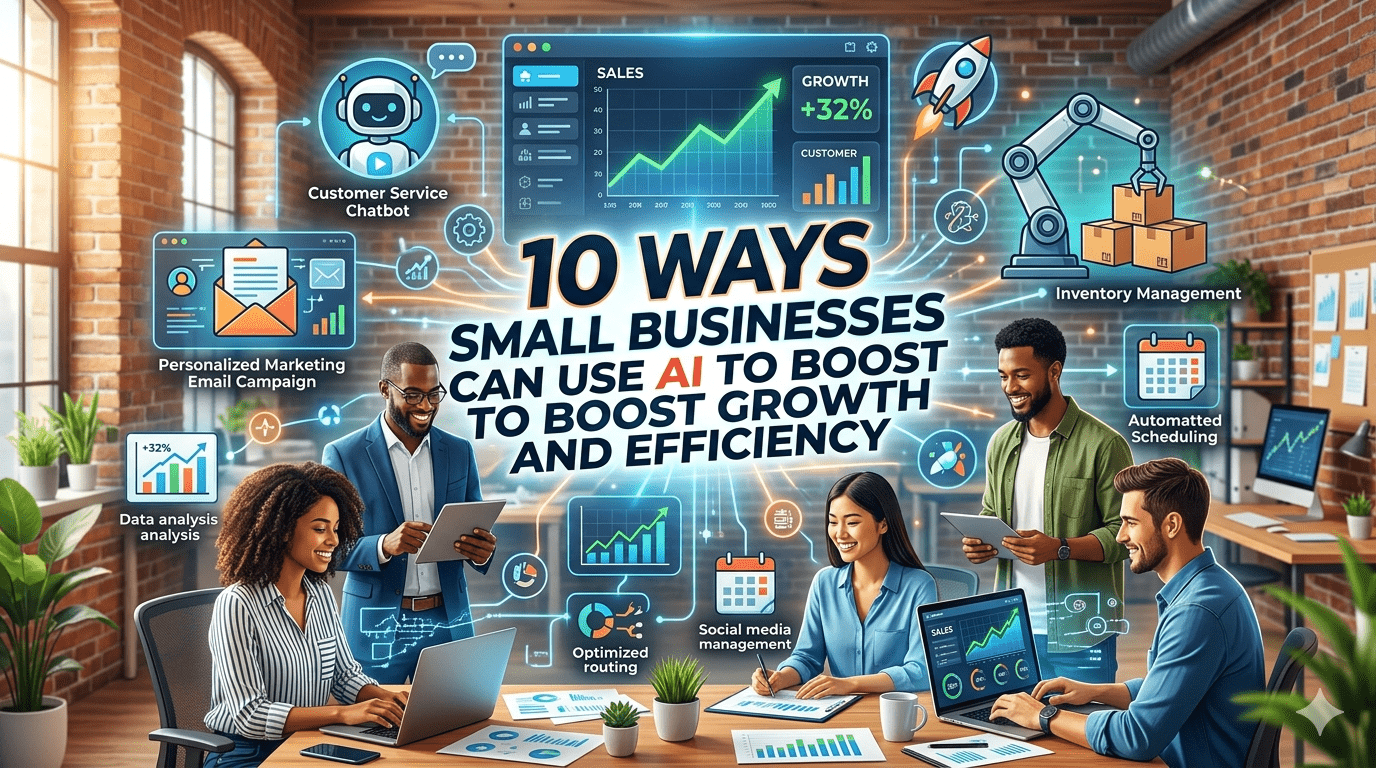
10 Ways Small Businesses Can Use AI to Boost Growth and Efficiency

10 Ways Small Businesses Can Use AI to Boost Growth and Efficiency

In today’s rapidly evolving digital landscape, artificial intelligence (AI) is no longer reserved for large enterprises with massive budgets. Small businesses now have access to powerful, affordable AI tools that can transform operations, increase efficiency, and drive measurable growth.

From automating repetitive tasks to delivering personalized customer experiences, AI empowers small businesses to compete at a higher level—without dramatically increasing overhead.

This guide explores 10 high-impact ways small businesses can use AI, along with actionable strategies for implementation, real-world applications, and best practices for maximizing ROI.

How Small Businesses Can Implement AI Effectively

Understanding the Basics of AI Technology

Artificial intelligence refers to systems that can analyze data, learn patterns, and make decisions with minimal human intervention. Core components include:

  • Machine Learning (ML): Learns from historical data to predict outcomes
  • Natural Language Processing (NLP): Enables chatbots, voice assistants, and text analysis
  • Predictive Analytics: Forecasts trends based on data patterns
  • Automation Algorithms: Replace manual, repetitive processes

For small businesses, the focus should be on practical application, not technical complexity. The goal is to use AI to save time, reduce costs, and improve decision-making.

Choosing the Right AI Tools for Your Business

Selecting the right tools is critical. Focus on solutions that:

  • Solve a specific operational problem
  • Integrate with existing systems (CRM, website, POS)
  • Offer scalability as your business grows
  • Provide ease of use and onboarding support

Common entry-level AI tools include:

  • Chatbots for customer service
  • Email marketing automation platforms
  • CRM systems with AI insights
  • Inventory forecasting software

Steps for Successful AI Implementation

  1. Identify inefficiencies or bottlenecks
  2. Define clear KPIs (time saved, revenue growth, etc.)
  3. Start with one use case (pilot program)
  4. Train your team on tool usage
  5. Track performance and optimize continuously

Businesses that take a phased approach see faster adoption and stronger ROI.

What Are the Benefits of Using AI in Business?

Enhancing Customer Experience

AI allows businesses to deliver personalized, real-time interactions at scale. Examples include:

  • Chatbots providing instant support
  • Product recommendations based on browsing behavior
  • Automated follow-ups and reminders

This level of responsiveness improves:

  • Customer satisfaction
  • Retention rates
  • Conversion rates

Increasing Efficiency Through Automation

AI eliminates time-consuming manual tasks such as:

  • Data entry
  • Appointment scheduling
  • Invoice processing
  • Lead routing

This allows teams to focus on:

  • Revenue-generating activities
  • Strategic planning
  • Customer relationship building

Data-Driven Decision Making

AI transforms raw data into actionable insights. Instead of guessing, businesses can:

  • Identify top-performing products/services
  • Predict customer behavior
  • Optimize pricing strategies
  • Improve marketing ROI

10 Practical Ways Small Businesses Can Use AI

1. AI-Powered Customer Service (Chatbots & Virtual Assistants)

AI chatbots can handle:

  • FAQs
  • Appointment booking
  • Order tracking
  • Lead qualification

Impact:

  • 24/7 availability
  • Reduced support costs
  • Faster response times

2. Smart Marketing Automation

AI enhances marketing by:

  • Segmenting audiences automatically
  • Personalizing email campaigns
  • Optimizing ad targeting in real-time

Result: Higher engagement and conversion rates with less manual effort.

3. Predictive Analytics for Sales Growth

AI analyzes past behavior to predict:

  • Which leads are most likely to convert
  • When customers are ready to buy
  • Which products will perform best

This allows for proactive sales strategies instead of reactive ones.

4. Content Creation and Optimization

AI tools can assist with:

  • Blog writing
  • Social media captions
  • Ad copy
  • SEO optimization

Small businesses can maintain a consistent content strategy without a large marketing team.

5. AI-Driven SEO Strategy

AI helps improve search visibility by:

  • Identifying keyword opportunities
  • Analyzing competitor content
  • Optimizing on-page SEO
  • Structuring content for AI search results (AEO)

This is critical as search behavior shifts toward AI-generated answers and voice search.

6. Inventory Management and Demand Forecasting

AI systems analyze:

  • Historical sales data
  • Seasonal trends
  • Customer demand patterns

Benefits:

  • Reduced overstock and stockouts
  • Improved cash flow
  • Better supply chain efficiency

7. Automated Financial Management

AI tools can streamline:

  • Bookkeeping
  • Expense tracking
  • Fraud detection
  • Financial forecasting

This reduces human error and provides real-time financial visibility.

8. AI in Hiring and HR Processes

AI can assist with:

  • Resume screening
  • Candidate matching
  • Interview scheduling
  • Employee performance tracking

This shortens hiring cycles and improves candidate quality.

9. Personalized Customer Experiences

AI enables hyper-personalization by analyzing:

  • Purchase history
  • Website behavior
  • Engagement patterns

Examples include:

  • Personalized product recommendations
  • Dynamic website content
  • Targeted promotions

10. Business Process Automation

AI can streamline entire workflows, including:

  • Lead management pipelines
  • CRM updates
  • Internal communications
  • Reporting and analytics

This creates a more agile and scalable business operation.

How AI Technology Transforms Business Processes

Automating Repetitive Tasks

AI reduces the need for manual intervention in routine operations. This leads to:

  • Increased productivity
  • Lower labor costs
  • Faster execution

Machine Learning Applications in Business

Machine learning continuously improves performance by learning from data. Common applications include:

  • Sales forecasting
  • Customer churn prediction
  • Risk analysis

Over time, systems become more accurate and valuable.

AI-Powered Analytics for Competitive Advantage

AI analytics tools provide:

  • Real-time dashboards
  • Predictive insights
  • Performance benchmarking

Businesses can make faster, smarter decisions with confidence.

Challenges of Using AI in Small Businesses

Overcoming Resistance to Adoption

Common concerns include:

  • Fear of job replacement
  • Lack of technical knowledge
  • Uncertainty about ROI

Solution: Provide training, emphasize augmentation (not replacement), and demonstrate quick wins.

Budget Considerations

While AI is more accessible than ever, costs still matter. Best practices include:

  • Start with low-cost tools
  • Focus on high-impact use cases
  • Scale gradually based on ROI

Data Privacy and Security

AI relies on data—making compliance essential.

Businesses must ensure:

  • Secure data storage
  • Transparent data usage
  • Compliance with regulations (GDPR, CCPA)

This builds trust and protects brand reputation.

Why Work with The AD Leaf Marketing Firm?

At The AD Leaf ® Marketing Firm, we specialize in helping small businesses leverage AI to drive measurable growth.

What Sets Us Apart:

  • Custom AI-driven marketing strategies tailored to your business
  • SEO + AEO optimization for modern search visibility
  • Advanced automation systems to streamline operations
  • Full-service digital marketing support (web, social, paid ads, content)

We understand that business owners don’t have time to manage multiple platforms, optimize content, and analyze data simultaneously. That’s why we build integrated, scalable systems that work together to generate leads and increase efficiency.

Getting Started with AI in Your Business

If you’re new to AI, start with these steps:

  1. Identify one area of inefficiency
  2. Implement a simple AI tool (chatbot, automation, etc.)
  3. Measure results within 30–60 days
  4. Expand into additional areas based on success

The key is progress over perfection—small improvements compound quickly.

Frequently Asked Questions (FAQ)

What is the best AI tool for small businesses?

The best tool depends on your needs. Common starting points include:

  • Chatbots for customer service
  • CRM platforms with AI insights
  • Email marketing automation tools

Is AI expensive for small businesses?

No. Many AI tools offer affordable pricing tiers or free versions. The key is choosing tools that deliver clear ROI.

Can AI replace employees?

AI is best used to augment employees, not replace them. It handles repetitive tasks, allowing teams to focus on higher-value work.

How quickly can businesses see results from AI?

Many businesses see measurable improvements within 30–90 days, especially in areas like marketing automation and customer service.

How does AI improve marketing performance?

AI improves marketing by:

  • Targeting the right audience
  • Personalizing messaging
  • Optimizing campaigns in real time
  • Increasing conversion rates

Final Thoughts

Artificial intelligence is no longer a future concept—it’s a present-day competitive advantage. Small businesses that adopt AI strategically can:

  • Operate more efficiently
  • Make smarter decisions
  • Deliver better customer experiences
  • Scale faster with fewer resources

By starting small and focusing on high-impact applications, any business can unlock the power of AI.

Looking to integrate AI into your marketing and operations?

The AD Leaf Marketing Firm can help you build and implement a customized AI-driven strategy designed to generate leads, increase efficiency, and accelerate growth.

Contact us today to schedule a consultation and discover how AI can transform your business.

AI SEO Agency, Florida AI SEO Expert, AI search Optimization, Generative Engine Optimization, AI sEO vs SEO

AI SEO vs Traditional SEO: What’s the Difference?

AI SEO vs Traditional SEO: What’s the Difference?

Many business owners ask: “Is AI SEO just regular SEO with a new name?” The answer is no — while traditional SEO focuses on getting websites to rank in Google search results, AI SEO is about positioning your brand as the answer in AI-driven search engines like ChatGPT, Gemini, Bing Copilot, and voice assistants. As AI adoption grows, understanding this distinction is critical, especially for local businesses in Orlando that want to stay competitive and visible online.

In this guide, we’ll explore:

  • How traditional SEO works
  • How AI SEO differs from traditional SEO
  • Examples of AI SEO in action
  • A hybrid strategy for long-term visibility
  • Localized tactics for Orlando businesses

Traditional SEO Focuses On

Traditional search engine optimization (SEO), also called classic or conventional SEO, has been the backbone of online marketing for decades. It focuses on improving your website’s position in search engine results pages (SERPs) using tried-and-true techniques.

Key Components:

  • Keyword Targeting – Choosing high-value keywords your audience searches for and optimizing page titles, headers, and content around those terms.
  • Backlinks – Acquiring inbound links from authoritative websites to signal trustworthiness and relevance.
  • Rankings – Monitoring where your pages appear in SERPs and optimizing to climb higher.
  • Meta Optimization – Crafting meta titles and descriptions that attract clicks and reflect the page’s content.
  • Technical Health – Ensuring fast page speeds, mobile responsiveness, crawlability, and clean site architecture.

The ultimate goal: increase visibility in traditional Google search results to drive traffic and conversions.

AI SEO Focuses On: Generative Engine Optimization

AI SEO, also known as Answer Engine Optimization (AEO) or Generative Engine Optimization (GEO), goes beyond keywords and links. Its primary goal is to get your business mentioned inside AI-generated answers, rather than just appearing as a blue link.

Key Components:

  1. Entity Authority – Establish your brand as a recognized entity in your niche. AI models prioritize content that demonstrates expertise, experience, and authority.
  2. Structured Content – Use headings, bullet points, and FAQ sections so AI systems can easily parse and understand your content.
  3. Context Clustering – Create content clusters around a core topic to signal depth and relevance. For example, an AI SEO page for “Orlando marketing agencies” might include supporting posts about ChatGPT SEO, voice search optimization, and AI content strategy.
  4. Conversational Formatting – Write content in a Q&A or natural language format to align with how AI interprets user queries.
  5. Citation Probability – AI models prioritize content that is well-sourced, clear, and frequently referenced across authoritative channels.

The ultimate goal: become the source that AI systems cite as the definitive answer.

Example in Practice

Traditional SEO:
Your business might rank for:

“Marketing Agency Orlando”

AI SEO:
Your business appears when someone asks:

“Who is the best AI marketing agency in Orlando?”

Notice the difference: traditional SEO targets search visibility, while AI SEO targets answer visibility.

Why AI SEO Matters for Local Businesses

Local businesses, including those in Orlando, face a unique opportunity. AI-driven search prioritizes entities, local signals, and structured information. Businesses that adopt AI SEO early can dominate local searches, even if they are smaller than competitors.

AI SEO Benefits for Orlando Businesses:

  • Capture conversational search traffic: People ask AI assistants in natural language.

  • Increase credibility: AI prefers content from trusted sources.

  • Leverage local relevance: AI models use geographic signals to recommend local services.

  • Future-proof visibility: Search engines are evolving toward AI-first ranking models.

For instance, a roofing company in Orlando optimized for AI SEO might appear when someone asks,

“Which Orlando roofing company is recommended for AI-driven home improvement advice?”

This visibility wouldn’t have been possible with traditional SEO alone.

The Hybrid Strategy: Combining Traditional and AI SEO

The most effective strategy is not choosing one over the other. Forward-thinking agencies, like Ad Leaf Marketing, integrate both strategies for maximum visibility.

Hybrid Strategy Components:

  1. Technical SEO
    Maintain fast, mobile-friendly, and crawlable sites.
  2. Content Authority
    Produce authoritative, in-depth content with citations and references.
  3. Structured Data & Schema
    Add FAQ, Article, LocalBusiness, and Organization schema to help both search engines and AI understand your content.
  4. Conversational Formatting
    Use Q&A blocks, bulleted answers, and clear definitions for AI-friendly readability.
  5. Local Signals
    Optimize Google Business Profile, NAP consistency, and location-specific content to boost local AI visibility.

By combining these approaches, your business not only ranks in traditional SERPs but also becomes the go-to answer in AI-driven search results.

Step-by-Step AI SEO Implementation

Here’s how Orlando businesses can implement AI SEO today:

  1. Audit Your Website
    Identify content gaps, entity recognition issues, and structured data opportunities.
  2. Build Topic Clusters
    Organize content around main topics with supporting articles to signal depth.
  3. Add AI-Friendly FAQ Sections
    Use questions your customers actually ask. Example:

    • What is AI SEO?
    • How does AI SEO help my Orlando business?
    • Does AI replace traditional SEO?

  4. Optimize Structured Data
    Include schema for pages, services, articles, and FAQs.
  5. Focus on Entity Signals
    Ensure your brand is mentioned consistently online, across directories, review platforms, and citations.
  6. Create Conversational Content
    Write content in a natural, Q&A-friendly tone that aligns with AI understanding.

Leverage Local SEO Signals
Include Orlando-specific content, link to local partners, and highlight your presence in Florida.

Common AI SEO Mistakes to Avoid

  1. Ignoring structured data
    AI SEO requires machine-readable content. Without schema, AI may not cite your content.
  2. Writing only for humans
    AI SEO content must balance readability for humans and interpretability for AI systems.
  3. Neglecting entity authority
    AI models rank entities, not just pages. Your brand must be recognized across authoritative sources.
  4. Focusing solely on keywords
    Keywords alone won’t guarantee AI citations; context, topical depth, and clarity matter more.

Skipping local signals
AI considers geography for recommendations. Neglecting local relevance limits visibility.

Measuring AI SEO Success

Traditional metrics like page rank and organic traffic remain useful, but AI SEO requires additional measurement methods:

  • AI mentions in answer boxes or generative answers
  • Featured snippet appearances
  • Voice search citations
  • ChatGPT and Gemini answer visibility (tools are emerging for monitoring)
  • Local question & answer search growth

Monitoring these will help you refine your strategy and stay ahead of competitors.

Future Trends in AI SEO

  1. Conversational AI Integration
    AI assistants will increasingly provide real-time recommendations, highlighting businesses optimized for AI search.
  2. Voice Search Expansion
    As voice search grows, conversational formatting and answer-focused content will become essential.
  3. Local Entity Domination
    AI will prioritize hyper-local entities; Orlando businesses can gain a first-mover advantage.
  4. AI-Driven Content Personalization
    Content tailored to user intent will be dynamically surfaced by AI, making structured content critical.
  5. Hybrid AI + Traditional SEO Tools
    SEO tools will increasingly offer AI optimization suggestions, merging analytics and generative intelligence.

Conclusion

AI SEO and traditional SEO are not the same, but both are crucial. Traditional SEO ensures your website is technically sound and visible in Google. AI SEO ensures your business is cited, recognized, and trusted by AI-powered systems, capturing the new generation of searchers.

For Orlando businesses ready to dominate both Google and AI-driven search, adopting a hybrid strategy now is essential. Agencies like The AD Leaf Marketing Firm are leading the way by integrating traditional SEO, AI optimization, structured content, and local signals; future-proofing their clients’ digital presence.

In 2026, businesses that ignore AI SEO risk becoming invisible in the channels where tomorrow’s customers are asking questions.

AI SEO Agency, Florida AI SEO Expert, AI search Optimization, Generative Engine Optimization, AI sEO vs SEO

AI SEO Strategies to Optimize for AI Search Results & Changing Search

AI SEO: Strategies to Optimize for AI Search Results & Changing Search

The world of search is changing, and if you’re not adapting your SEO strategies, you’re falling behind. Artificial intelligence is no longer a futuristic concept; it’s actively reshaping how search engines deliver information. You need to understand the implications of AI SEO to maintain or even improve your search engine rankings. Are you ready to optimize for AI and ensure your business stays visible in the changing search landscape?

Key Takeaways

  • AI is transforming search, requiring a shift from traditional SEO tactics to AI SEO strategies that focus on understanding and catering to AI algorithms.
  • To improve SEO performance, businesses must prioritize optimizing content for AI models like Google’s AI overviews, which aggregate information and provide AI answers directly within the search results.
  • Adapting your SEO strategies to consider the impact of AI-driven search and generative AI ensures your content is discoverable in both traditional search and the evolving AI search results page.
  •  By integrating AI tools, understanding search behavior, and focusing on generative engine optimization, businesses can enhance their AI visibility and improve search engine rankings in the age of AI.

Understanding AI and Its Impact on SEO

The rise of artificial intelligence is undeniably reshaping the search landscape, creating a new era for search engine optimization. Traditional SEO, focused on algorithms and keyword optimization, must now evolve to incorporate AI SEO strategies that account for AI systems and their influence on search results. With Google’s AI and similar technologies becoming increasingly prevalent, understanding how AI algorithms process and present information is critical to maintaining visibility.

What is AI and How Does it Reshape Search?

Artificial intelligence, at its core, is the simulation of human intelligence in machines, enabling them to perform tasks that typically require human intellect. In the context of search, AI algorithms are used to understand user intent, analyze vast amounts of data, and deliver more relevant and personalized search results. As AI is reshaping search, businesses need to adapt their content strategies to ensure they are optimized not just for traditional search engines like Google, but also for AI-powered search. To enhance AI visibility and improve SEO performance, companies must understand how AI processes and presents information.

The Evolution of Search Engines in the Age of AI

Search engines have evolved significantly, transitioning from simple keyword-matching algorithms to sophisticated AI systems that analyze context, user behavior, and intent. Traditional search engines relied on indexing websites based on keywords, but the age of AI has ushered in a new era of understanding the nuances of language and providing AI answers. This evolution demands a shift in SEO strategies, focusing on creating content that satisfies both traditional search algorithms and the complex AI models used by search engines like Google.

Key AI Overviews in Search Engine Technology

AI overviews, exemplified by Google’s AI overviews or ChatGPT, are changing the way search results are presented. These AI summaries provide users with concise answers generated from multiple sources, directly on the search engine results page. With tools like these, users can quickly access the information they need without navigating through multiple websites. For AI SEO, this means optimizing content to be featured in these AI overviews and ensuring that your information is accurately represented in AI-generated summaries.

What are Google AI Overviews?

Google’s AI overviews are a prime example of how generative AI is transforming the search experience. These overviews provide concise, AI answers to user queries directly on the search engine results page, aggregating information from various sources to offer a comprehensive summary. As Google’s search prioritizes AI-driven results, businesses must optimize content to be prominently featured in these AI summaries. By focusing on generative engine optimization and understanding how Google’s AI algorithms work, businesses can enhance their AI visibility and improve their search engine rankings.

How Do Google AI Overviews Work?

Google’s AI overviews work by leveraging advanced AI models to analyze search queries and identify the most relevant and authoritative information across the web. These AI algorithms then synthesize this information into a concise summary displayed at the top of the search engine results page. To optimize content for these AI overviews, businesses must focus on creating comprehensive, accurate, and well-structured content that addresses specific user intents. Understanding how these systems work is key to improving SEO performance in the age of AI.

SEO Strategies for AI-Driven Search Results

How to Optimize Content for AI Search Engines

To effectively optimize content for AI search engines, focus on creating comprehensive, high-quality material that directly addresses user intent. By understanding how AI algorithms analyze and rank content, businesses can improve their AI visibility and search engine rankings. Employing AI SEO strategies involves not only optimizing keywords, but also ensuring content is well-structured, accurate, and provides clear, concise answers that AI models can easily extract and present in AI overviews or AI summaries. Prioritize generative engine optimization to leverage AI in content creation and optimization processes. This proactive approach will enhance your ability to rank higher in the changing search landscape.

Implementing AI Tools for Enhanced SEO

Implementing AI tools can significantly enhance SEO strategies, offering businesses a competitive edge in the age of AI. By leveraging AI algorithms, these tools can analyze vast amounts of data to identify search trends, optimize content, and improve search engine optimization performance. AI empowers SEO through various capabilities, including:

  • Generating high-quality content with tools like ChatGPT.
  • Assisting in keyword research, competitor analysis, and tracking search engine rankings.

By integrating these tools into your SEO workflow, you can optimize content more efficiently and effectively, ensuring better AI visibility and improved search engine rankings. Adapting your content strategies to include AI tools is essential for staying ahead in the evolving search landscape.

Addressing Common SEO Issues in AI Contexts

Addressing common SEO issues in AI contexts requires adapting traditional SEO practices to meet the demands of AI-driven search. With Google’s AI and other AI search technologies prioritizing comprehensive, accurate, and well-structured content, businesses must ensure their content aligns with these standards. Common issues include thin content, lack of clear answers, and poor user experience, all of which can negatively impact AI visibility and search engine rankings. By focusing on quality content strategies, technical SEO improvements, and understanding how AI algorithms evaluate content, businesses can mitigate these issues and improve their SEO performance in the age of AI. Optimizing for AI involves understanding how AI search presents information and ensuring content is easily digestible.

Adapting Traditional SEO Strategies for AI

Comparing Traditional SEO and AI SEO

Traditional SEO focused primarily on keyword optimization and link building to improve search engine rankings. AI SEO, on the other hand, requires a deeper understanding of user intent and the ability to create content that satisfies AI algorithms. While traditional SEO still holds value, adapting traditional SEO strategies for AI involves creating comprehensive, accurate content that can be easily understood by AI models. This includes optimizing for AI overviews, AI summaries, and AI-powered search results. Businesses must prioritize generative engine optimization to enhance AI visibility and improve SEO performance in the age of AI, understanding how Google’s AI is reshaping the search landscape.

SEO Strategies for the Future: What Will Change in The Near Future?

By 2030, SEO strategies will be heavily influenced by AI algorithms and AI-driven search results. As Google’s search continues to prioritize AI, businesses must focus on generative engine optimization to ensure their content is prominently featured in AI overviews. The future of search will see a greater emphasis on understanding user intent, creating comprehensive content, and leveraging AI tools to enhance SEO performance. With AI-powered search becoming more prevalent, traditional SEO tactics will need to evolve to incorporate AI SEO strategies that cater to AI models and their ability to analyze and present information. By adapting their content strategies to meet the demands of AI, businesses can maintain and improve their search engine rankings in the evolving search landscape.

Using AI to Improve Search Visibility

Using AI to improve search visibility involves leveraging AI tools and AI SEO strategies to optimize content for AI algorithms and AI-driven search results. Businesses can use AI to analyze search trends, identify relevant keywords, and create high-quality content that satisfies user intent. Optimizing for AI overviews, AI summaries, and AI-powered search is crucial for enhancing AI visibility and improving SEO performance. By understanding how AI search engines process and present information, businesses can tailor their content strategies to meet the demands of AI, ensuring that their content is prominently featured in the changing search landscape. Harnessing AI can lead to better SEO rankings, especially in the age of Google’s AI.

Building Topical Authority

What is Semantic SEO

Semantic SEO is an AI SEO approach that focuses on understanding the intent and context behind search queries, rather than just optimizing for keywords. It involves creating content that satisfies user intent, provides comprehensive answers, and establishes a clear relationship between different topics. By focusing on semantic SEO, businesses can improve their AI visibility and search engine rankings by providing AI algorithms with a deeper understanding of their content.

Topic Clusters

Topic clusters are a content strategy that offers several benefits. This strategy involves organizing related content around a central “pillar” page, with supporting “cluster” pages linking back to it. This approach yields advantages such as:

  • Helping search engines understand the relationships between different topics on a website.
  • Improving SEO performance.

When using AI tools for this, it optimizes content for AI algorithms. By creating topic clusters, businesses can enhance their AI visibility, improve search engine rankings, and demonstrate expertise in a specific area, catering effectively to Google’s AI.

Internal Linking Structure

Here’s how an effective internal linking structure can help with AI SEO:

  • It helps search engines navigate and understand the relationships between different pages on a website.
  • By linking related content together, businesses can improve their AI visibility and boost search engine rankings.

Using AI tools to analyze and optimize internal linking structures can further ensure that content is easily discoverable by both users and AI algorithms.

Content Strategies for AI Search Optimization & AI Overviews

Creating Content that Appeals to AI Models

Creating content that appeals to AI models requires a strategic approach focused on satisfying user intent, providing comprehensive answers, and optimizing for AI overviews and AI summaries. Ensure that the content is well-structured, accurate, and provides clear, concise answers that AI algorithms can easily extract. As AI search continues to evolve, businesses must adapt their content strategies to meet the demands of AI, enhancing their AI visibility and improving SEO performance.

The Role of AI in Content Creation and Optimization

The role of AI in content creation and optimization is becoming increasingly significant, as AI tools can assist in various aspects of the content creation process. From keyword research and topic generation to content writing and editing, AI algorithms can help businesses create high-quality content more efficiently. By leveraging AI, businesses can enhance their AI visibility, improve search engine rankings, and stay ahead in the changing search landscape.

Measuring Success: AI Search Results and Analytics

Measuring success in AI search requires a different set of metrics and analytics compared to traditional SEO. Tracking AI visibility, monitoring AI overviews and AI summaries, and analyzing user engagement with AI-powered search results are essential for understanding the effectiveness of AI SEO strategies. By using AI tools to analyze search trends and search behavior, businesses can gain valuable insights into how their content is performing and make data-driven decisions to improve their SEO performance. By 2025, measuring AI search results will be pivotal for the SEO health of your business.

7 Strategies for Optimizing for AI Overviews in Google Search

To enhance your SEO strategies, especially in the evolving landscape of AI search, consider several key adjustments. The integration of AI overviews in Google Search necessitates that your SEO performance aligns with how AI algorithms assess content. By understanding and implementing these strategies, you can optimize content for AI and ensure your content is prominently featured in AI search results. These AI SEO strategies are crucial for AI visibility and better search engine rankings.

1. Be More Specific with Your Content

Specificity is key when optimizing content for AI overviews. Google’s AI algorithms prioritize clear, concise answers that directly address user queries. By focusing on creating highly specific and targeted content, you increase the likelihood that your information will be accurately represented in AI summaries. Optimize content by providing clear and detailed explanations that AI models can easily understand and extract. Adapting traditional SEO to include AI involves pinpointing user intent with precision, ensuring content aligns directly with those needs to boost SEO performance.

2. Think Topics, not Keywords

Traditional SEO relied heavily on keyword optimization, but in the age of AI, it’s essential to shift your focus to topics. AI algorithms understand the context and relationships between different concepts, so creating comprehensive content around specific topics can improve your search engine rankings. By developing topic clusters, businesses can improve their AI visibility and provide AI systems with a deeper understanding of their content. Use AI to explore and map the network of subtopics and related concepts around your core topics.

3. Links as Trust and Authority Signals

Links remain a crucial ranking factor, but their role is evolving in the age of AI search. AI algorithms use links as trust and authority signals to determine the credibility and reliability of content. By building high-quality backlinks from authoritative sources, businesses can improve their AI visibility and boost their search engine rankings. Ensure that your content is cited and linked to by reputable websites, signaling to AI systems that your information is trustworthy and valuable.

4. Use Structured Data and Citations

Structured data and citations are essential for optimizing content for AI overviews. By implementing schema markup, you provide AI algorithms with additional context about your content, making it easier for them to understand and extract relevant information. Use citations to support your claims and demonstrate the accuracy and credibility of your content. These structured elements help AI models present your content accurately in AI summaries.

5. Leverage Multimedia and Voice Search for Better Rankings

To thrive in AI SEO, leverage multimedia and optimize for voice search to enhance your AI visibility and search engine rankings. As AI search becomes more sophisticated, integrating diverse content formats and catering to voice queries will improve your SEO performance. By adapting content strategies, including voice search optimization, businesses can enhance their AI visibility and stay ahead in the changing search landscape.

6. Adopt an “Always-On” Mentality

Adopting an “always-on” mentality is crucial in AI SEO. The search landscape is constantly evolving, and AI algorithms are continuously learning and adapting. To maintain and improve your SEO performance, businesses must continuously monitor their search engine rankings, analyze search trends, and adapt their content strategies accordingly. By staying proactive and responsive, you can optimize content for AI and ensure your business remains visible in the changing search landscape.

7. Monitor and Adapt to AI Overviews for Better Search Engine Rankings

Consistently monitor and adapt to AI overviews to improve your search engine rankings. Since Google’s search is prioritizing AI-driven results, businesses must optimize their content to be prominently featured in AI summaries and adapt their SEO strategies to cater to AI models. By understanding how these systems work, you can better optimize content for AI, ensuring that your information is accurately represented and positively impacts your SEO performance.

Working with an AI SEO Agency | The AD Leaf Marketing Firm

Navigating the complexities of AI SEO can be challenging, but partnering with an experienced AI SEO agency like The AD Leaf Marketing Firm can help your business thrive in the changing search landscape. At The AD Leaf, we understand how AI algorithms work and can develop customized AI SEO strategies to improve your AI visibility and boost your search engine rankings. Our team of experts leverages AI tools and innovative approaches to optimize content for AI overviews, ensuring your business stays ahead in the age of Google’s AI. We guide businesses to optimize content for AI, focusing on generative engine optimization and using AI to boost search engine rankings.

The Future of Search: Trends and Predictions

The future of search is inextricably linked with AI. AI algorithms are already influencing search engine results pages, and as AI technology continues to evolve, its impact on search will only grow. By 2025, AI SEO strategies will be essential for maintaining and improving search engine rankings. Businesses must understand how AI models work and adapt their content strategies accordingly to stay visible in the changing search landscape.

How AI is Revolutionizing SEO Practices

Artificial intelligence is revolutionizing SEO practices, transforming traditional SEO approaches into AI SEO strategies that cater to AI algorithms. By understanding how AI models analyze and rank content, businesses can optimize their websites to improve AI visibility and boost search engine rankings. AI tools are becoming increasingly essential for keyword research, content creation, and competitor analysis, enabling businesses to stay ahead in the age of AI. Optimize content for AI with us.

Preparing for the Changing Search Landscape

Preparing for the changing search landscape requires a proactive approach focused on understanding and adapting to AI-driven search results. As Google’s search continues to prioritize AI, businesses must optimize content for AI overviews and AI summaries to improve their AI visibility. Staying informed about the latest AI algorithms and search trends is crucial for maintaining and improving search engine rankings in the evolving search landscape. Be ready to optimize for AI to future-proof your business.

Engaging with AI-Powered Search Technologies

Engaging with AI-powered search technologies involves actively leveraging AI tools and AI SEO strategies to improve your online presence. By using AI to analyze search behavior, identify relevant keywords, and create high-quality content, businesses can optimize their websites for AI algorithms. Optimize content for AI, enhancing AI visibility and improving SEO performance in the age of AI-driven search results. This strategy ensures your business thrives in the changing search landscape.